
Identity change through practice
You change your identity by changing what you repeat.
Identity is not a label you declare once. It is who you practice being until the evidence is hard to ignore.
Identity is practiced, not announced
Social media loves identity declarations. New year, new me. The quiet part is practice. Identities change when behavior changes often enough that your brain updates the story. Announcements get likes. Repetition gets results, usually without an audience until the pattern is obvious. The label follows the votes, and reversing that order is why so many identity changes collapse after the post fades from the feed and Tuesday looks unchanged again.
You can say you are a runner. You become a runner when running is what you do often enough that skipping feels like the exception. The label follows the votes. Reversing that order is why so many identity changes collapse after the post fades from the feed. The new identity wins when it gets more daily reps than the old one over months, not when you win one dramatic week and declare victory while triggers remain unchanged.
Practice also means the old identity will still show up under stress for a while. That is not failure. It is lag. You are editing, not erasing. The new identity wins when it gets more daily reps than the old one over months, not when you win one dramatic week and declare victory. Editing is a competition for repetition, not a single ceremony where you burn the old label, because old identities do not vanish just because you renamed yourself in a journal.
Name the identity you are practicing
Vague change fails. Name the identity in plain language: Becoming, Calm, Reader, Smoke-Free. Say it out loud once. Then attach two actions that would prove it today. If you cannot name actions, the identity is still a mood board, not a practice. The name should invite a small vote today, not a performance of a finished person you are not yet, so pick language that feels true enough to practice on a tired evening.
Reinvention is editing who you practice being, not erasing your past. Old identities do not vanish because you renamed yourself. They lose votes when the new identity gets more daily reps. Editing is a competition for repetition, not a single ceremony where you burn the old label. Two proofs keep the bar low enough to return after a miss, and identity change is a ratio over time, not a single perfect day you cannot repeat when stress returns.
Pick a name that feels true enough to practice, not aspirational enough to intimidate you. Becoming a writer may work better than Author if the latter makes you freeze. The name should invite a small vote today, not a performance of a finished person you are not yet. Make proofs observable so you cannot negotiate yourself out of the evidence at night, because I thought about being calm is not proof, but I paused for sixty seconds before replying is.
Complete two proofs per day
Two small actions is enough to start. Not ten. Two proofs that the new identity is real today. Log them. Miss a day and log that too. Identity change is a ratio over time, not a single perfect day. Two proofs keep the bar low enough to return after a miss. That mirror is useful when your memory rewrites the story to protect your ego or your shame, and Ascend shows whether your week matched the identity you named without psychoanalyzing you.
Ascend import plans include identity-shift habits you can edit. The app does not psychoanalyze you. It shows whether your week matched the identity you named. That mirror is useful when your memory rewrites the story to protect your ego or your shame. A minute of different behavior does not fix your life, but it proves the edit is possible right now, which is how new identities gain territory in the gaps old scripts used to own.
Proofs should be physical or behavioral, not mental. "I thought about being calm" is not proof. "I breathed for sixty seconds before replying" is proof. Make the actions observable so you cannot negotiate yourself out of the evidence at night when the old story feels more convincing. A trigger explains the pull without removing responsibility to practice the new identity at the smallest scale you can manage, so explanation plus one small vote beats explanation plus surrender.
Ready to practice a different identity starting today?
Notice when the old identity shows up
Old identities have triggers. Stress, boredom, certain people, certain hours. Notice the moment the old script offers relief: scroll, snack, avoid, lash out. Naming the moment creates a pause. In the pause, you have a choice that did not exist when the script ran automatically. Most identity change fails at the habit design layer, not the desire layer, so change the action before you abandon the identity when mismatch shows up in weekly review.
In the pause, ask what the new identity would do for sixty seconds. Not forever. Sixty seconds. Identity change lives in those gaps. A minute of different behavior does not fix your life. It proves the edit is possible right now, which is how new identities gain territory. Keep the identity unless you have months of honest proof that it does not matter to you, because often you picked the right identity with the wrong habit design and timing.
Track triggers in weekly review without turning them into excuses. A trigger explains the pull. It does not remove responsibility to practice the new identity at the smallest scale you can manage. Explanation plus one small vote beats explanation plus surrender. If you named Calm and never logged a calming action, the problem is clear, and if you logged ten actions at midnight when you were wired, the problem is timing, not character.
Adjust actions that do not match
Weekly identity review is not confession. It is editing. Which actions supported the new identity? Which were too big, wrong time, or wrong fit? Change the action before you abandon the identity. Most identity change fails at the habit design layer, not the desire layer. Keep practicing through the middle, because change happened in the boring weeks they did not see, and your job is those weeks, not the compliment that arrives with lagging recognition.
Identity change fails when people think mismatch means they picked the wrong person to become. Often they picked the right identity with the wrong habit design. Shrink, move, or swap the action. Keep the identity unless you have months of honest proof that it does not matter to you. Gradual practice lets you test whether the new identity fits your real life before you reorganize everything around it, so slowness is data collection, not weakness or lack of commitment.
Ascend weekly review makes mismatch visible. If you named Calm and never logged a calming action, the problem is clear. If you logged ten actions but all at midnight when you were wired, the problem is timing. Edit like an engineer, not a judge. It is a practice log for who you are becoming, not a cure for your past, and it will not block temptations or replace therapeutic work when identity is tangled with trauma.
Identity change is slow and that is normal
Movies compress identity change into a training montage. Real life gives you awkward middle months where you are not fully old or new. That middle is where most people quit because the gap feels embarrassing. Keep practicing through the middle. The evidence accumulates quietly. You already know what you want to change and struggle to see whether your week matched the identity you named, so visibility without streak performance is the useful middle ground here.
One day someone calls you disciplined, calm, or creative and you almost argue before realising they might be right. That moment is lagging recognition, not the day change happened. Change happened in the boring weeks they did not see. Your job is the boring weeks, not the compliment. Rename habits until they fit, drop identities that were performative, and keep the ones that change how ordinary days feel, because identity change is editing who you practice being daily.
Slow change is also safer change. Identity edits that happen overnight are often performances that collapse. Gradual practice lets you test whether the new identity fits your real life before you reorganize everything around it. Slowness is data collection, not weakness. Announcements get likes but repetition gets results, usually without an audience until the pattern is obvious enough that skipping feels like the exception instead of the default for you again.
What Ascend does for identity change
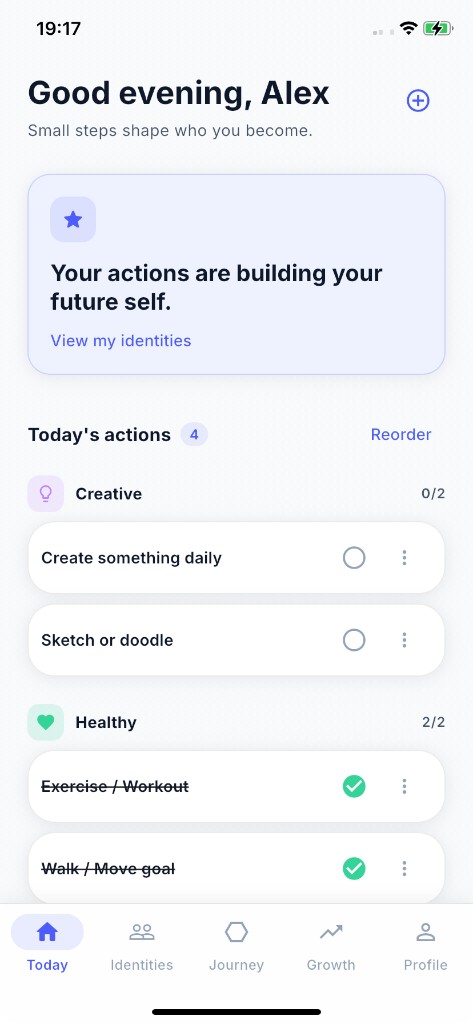
Ascend gives you identities, daily actions, and weekly review in one place. Import a plan or build your own. It will not block temptations or replace deep therapeutic work when identity is tangled with trauma. It is a practice log for who you are becoming, not a cure for your past. In the pause, you have a choice that did not exist when the script ran automatically, and naming the moment creates space for sixty seconds of different behavior that counts as proof.
For many people, that log is the missing piece between insight and behavior. You already know what you want to change. You struggle to see whether your week matched the identity you named. Ascend makes that visible without turning your life into a streak performance. Mismatch means edit the habit, not abandon the person you are becoming, unless months of honest review show the identity itself no longer fits the life you actually want.
Use it honestly. Rename habits until they fit. Drop identities that were performative. Keep the ones that change how ordinary days feel. Identity change is editing who you practice being. The app holds the edit log. You still do the practice in the real world. The app holds the edit log while you do the practice in the real world, and honest use beats treating any tool like a substitute for the choices only you can make.
FAQ
How long does identity change take?
You may notice behavioral shifts in a few weeks, but identity that feels stable often takes several months of repeated practice and weekly adjustment.
Can I change multiple identities at once?
You can, but most people succeed with one or two active identities at a time. Competing identity practices dilute evidence and make review noisy.
Is Ascend free?
Ascend is free to download. Ascend Pro adds optional extras like unlimited identities and deeper insights via subscription.
Does my data leave my device?
Your identities, habits, and reviews are stored locally on your device by default.