
Habits that survive contact with real life
Better habits start with a better reason.
Building better habits is not about more willpower. It is about linking small actions to an identity you actually want to practice.
Why your current habits are not random
Every habit you have, good or bad, solved a problem at some point. Scrolling eased boredom. Snacking soothed stress. Skipping the gym protected you from feeling incompetent. Judging yourself for these patterns rarely removes the underlying trigger. Shame adds a second problem on top of the first without changing the loop. You are negotiating with a coping strategy that used to make sense, and until you respect the function of the old habit, the new one will lose on hard days when you need relief fast.
Better habits start with honesty about what the old habit gives you short term. Then you design a replacement that meets some of the same need with less long-term cost. You are not fighting a random flaw. You are negotiating with a coping strategy that used to make sense in a context that may still be partially true. Map the loop with enough clarity to see where a smaller, kinder response could fit, because better habits start with honesty about what the old habit gives you short term.
Map the loop: cue, craving, response, reward. You do not need academic precision. You need enough clarity to see where a smaller, kinder response could fit. Until you respect the function of the old habit, the new one will lose on hard days when you need relief fast. The old habits will still show up under stress until the new ones have enough history to compete, so name the identity in plain language before you optimize the mechanics.
Link habits to identity
A habit without identity is a chore. A habit with identity is evidence. "Read ten pages" becomes "readers read." "Walk after dinner" becomes "healthy people move." That link is the difference between a checklist and a practice. Chores get dropped when life gets loud. Practices get shrunk and returned to. If you cannot say who you are practicing being, the habit is probably someone else's advice, and identity-first design keeps you honest about why this action matters on a flat Wednesday.
Reinvention is editing who you practice being, not erasing your past. You are not deleting old habits overnight. You are gradually giving more reps to behaviors that match who you want to become. The old habits will still show up under stress until the new ones have enough history to compete. The habit can grow after the entry point is boringly easy to hit, because friction is silent sabotage and you often blame willpower when the good choice takes five extra steps.
Name the identity in plain language before you optimize the habit. If you cannot say who you are practicing being, the habit is probably someone else's advice. Identity-first design keeps you honest about why this action matters on a Wednesday when nothing feels inspiring. Fix one friction point before you add a new habit, whether it is a cluttered space, a missing item, or a phone in your hand when the cue should trigger something better.
Make good habits obvious and easy
Better habits fail when they are hidden behind friction. Book on the nightstand beats book on a shelf. Gym bag packed beats gym bag hunted at 6am. Water bottle full beats remembering to drink later. Friction is silent sabotage. You blame willpower when the real issue is that the good choice takes five extra steps. Logging closes the loop so the stack becomes data, not just a good intention you forget by Thursday when life gets loud and the old default returns without you noticing.
Spend more time reducing friction than increasing motivation. Motivation is unreliable. A clear cue and a two-minute entry point are not. Design the path so the first move is almost automatic. The habit can grow after the entry point is boringly easy to hit. Choose anchors that happen daily and are hard to skip, because if the anchor is inconsistent, fix the anchor first or pick a different one before you blame the new behavior.
Audit friction weekly. What slowed you down this week? A cluttered space, a missing item, a phone in your hand? Fix one friction point before you add a new habit. Better habits are often environment problems solved with a drawer, a reminder, or a moved object, not a character upgrade. The identity grows from showing up, not from ideal sessions that happen twice a month and then disappear, leaving you with proof that you cannot be trusted to continue.
Ready to practice a different identity starting today?
Stack onto what already works
Habit stacking attaches a new behavior to an existing one. After I brush my teeth, I stretch for two minutes. After I sit at my desk, I write one sentence. The old habit becomes the reminder for the new one. You borrow reliability from something you already do without thinking. Celebrate the minimum version on hard days as loudly as the full version on good days, because both are votes for the same identity and one is just sized for reality.
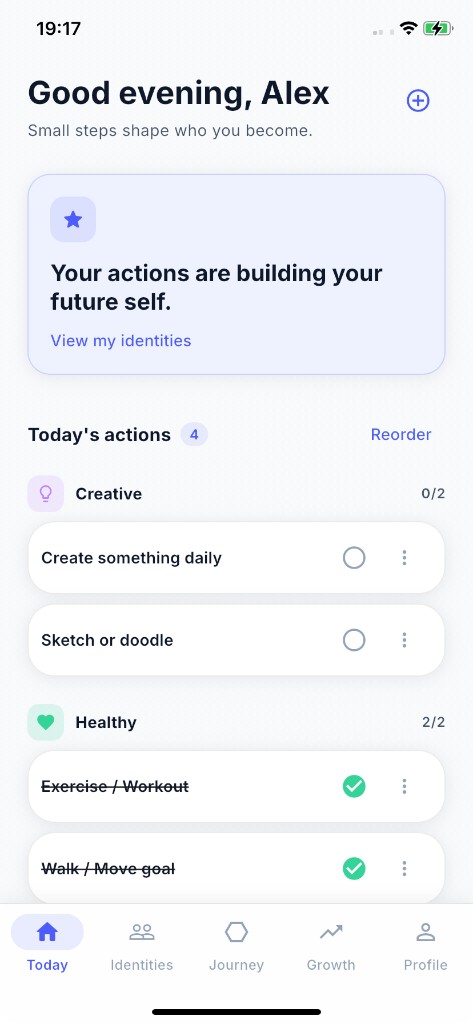
Ascend import plans include starter stacks you can edit. The app will not redesign your kitchen or your commute. It helps you name the stack and track whether you actually did it. Logging closes the loop so the stack becomes data, not just a good intention you forget by Thursday. Binary rules feel disciplined until they guarantee dropout, so a partial vote still counts because your brain learns from frequency more than from occasional heroics you cannot repeat.
Choose anchors that happen daily and are hard to skip. Coffee, brushing teeth, locking the door, opening the laptop. Weak anchors produce weak stacks. If the anchor is inconsistent, fix the anchor first or pick a different one. The stack is only as stable as its foundation. Drift is normal and review is how you notice it before it becomes a new default you did not choose, especially when life got busy and you forgot why the habit mattered.
Celebrate completion, not perfection
Perfectionism kills habit building. If you only count a workout when it is an hour long, you will skip most days. If you count a ten-minute walk, you build a pattern of showing up. The identity grows from showing up, not from ideal sessions that happen twice a month and then disappear. Cutting a habit is not failure; it is editing, and the goal is alignment, not accumulation of obligations that made sense in January and hurt in June when your load changed.
Better habits are built by people who protect momentum over ego. Done beats perfect. Returned beats abandoned. Celebrate the minimum version on hard days as loudly as the full version on good days. Both are votes for the same identity. One is just sized for reality. Curiosity produces design changes while prosecution produces shame spirals, so ask what got in the way before you issue a verdict about your character every Sunday night.
Perfection also hides in all-or-nothing thinking about timing. Morning workout or nothing. Full meditation or skip. Binary rules feel disciplined until they guarantee dropout. A partial vote still counts. Your brain learns from frequency more than from occasional heroics that cannot be repeated. If the same habit fails for six weeks, the design is wrong, the identity is wrong, or the load is too high, and you should change one of those before concluding you are broken.
Weekly review makes habits better
Without review, habits drift. You keep a habit that no longer serves the identity. You drop a habit that was working because life got busy and you forgot why it mattered. Drift is normal. Review is how you notice drift before it becomes a new default you did not choose. Honest limits keep expectations usable when motivation is low and stories in your head are unreliable, because visibility about weekly alignment is valuable even when change feels slow.
A weekly habit review asks which actions still match who you are becoming. Keep, shrink, or cut. Habits are tools, not tattoos. Cutting a habit is not failure. It is editing. The goal is alignment, not accumulation of obligations that made sense in January and hurt in June. Better habits are a design problem dressed up as a character problem, so use your life to remove obstacles while the app collects proof that your practice is real.
Bring curiosity to review, not prosecution. "What got in the way?" beats "What is wrong with me?" Curiosity produces design changes. Prosecution produces shame spirals and secret quitting. Better habits come from engineers who adjust systems, not judges who issue verdicts every Sunday. Chores get dropped when life gets loud, but practices get shrunk and returned to because they are tied to who you are becoming, not only what you think you should do.
Limits of habit apps
Ascend is strong at identity-linked tracking and weekly review. It is not a blocker for addictive apps, a meal plan, or a therapist. Better habits still require environment design and sometimes professional help. The app is one layer in a stack, not the whole stack. Spend more time reducing friction than increasing motivation, because a clear cue and a two-minute entry point outperform inspiration that arrives unpredictably and disappears by evening.
Use the app to collect proof. Use your life to remove obstacles. Building better habits is a design problem dressed up as a character problem. If the same habit fails for six weeks, the design is wrong, the identity is wrong, or the load is too high. Change one of those before you conclude you are broken. Habit stacking borrows reliability from something you already do without thinking, which is why after I brush my teeth or pour coffee are durable anchors for new behaviors.
Honest limits keep expectations usable. Ascend will not fix a toxic job, heal trauma, or automate your kitchen. It will show whether your week matched the person you said you were becoming. That visibility is valuable when motivation is low and stories in your head are unreliable. Ascend is one layer in a stack, not the whole stack, and better habits still require environment design and sometimes professional help when triggers run deeper than tracking alone can hold.
FAQ
How many habits should I build at once?
Most people do best with one new habit at a time, or two if one is very small. Adding many habits at once usually means none of them stick past three weeks.
What is the best way to track habits?
Track habits tied to an identity and review weekly. Daily checkmarks alone often become streak anxiety. Identity tracking asks whether your actions matched who you want to become.
Is Ascend free?
Ascend is free to download. Ascend Pro adds optional extras like unlimited identities and deeper insights via subscription.
Does my data leave my device?
Your identities, habits, and reviews are stored locally on your device by default.