
When you get in your own way
Self-sabotage is often identity protection, not self-destruction.
If you keep undermining your own progress right when things start to work, you are probably not broken. You are probably defending an old story about who you are allowed to be.
Sabotage shows up right on schedule
The pattern is painfully familiar. You start eating better, and by week three you are back to late-night snacking. You commit to a project, make real progress, then suddenly find reasons to delay. You get close to a goal and somehow manufacture a setback that only you could have caused.
From the outside it looks irrational. From the inside it often feels like "I do not know why I did that again." That confusion is a clue. Self-sabotage is rarely random. It tends to appear when a new version of you is starting to feel real.
Consistency problems are usually identity problems in disguise. Sabotage is what happens when the new identity threatens an old one that still feels safer, even if you are tired of it.
Notice where sabotage tends to strike. Right before a milestone. Right after praise. Right when the new routine starts to feel real. Those are not random weak moments. They are the old identity defending territory.
Your brain prefers a familiar story
People are not only motivated by what they want. They are also motivated by what feels coherent. If you have spent years being "the person who starts strong and fades" or "the one who never quite follows through," then real progress creates tension. Success does not just bring rewards. It brings identity whiplash.
Sabotage can be an unconscious way to restore the old story. Miss the deadline, break the streak, pick the old habit, and suddenly the world makes sense again. Painful, but familiar.
That does not mean you secretly want to fail. It means part of you has not been given a believable alternative identity yet. "Successful, consistent person" is still a costume, not a self.
Familiar failure can feel safer than unfamiliar success because success changes how other people see you, how you see yourself, and what you might be expected to repeat. Sabotage is sometimes a clumsy attempt to stay recognizable, even to yourself.
One way to lower the threat is to make the new identity narrower. Not a whole life upgrade. One role, one context, one small set of actions. The old self feels less attacked when the new one arrives as a side practice instead of a total replacement.
Shame makes the loop tighter
After sabotage, most people reach for self-criticism. Harsh inner commentary feels like accountability, but it usually deepens the old identity instead of replacing it. "There I go again" is not analysis. It is rehearsal.
Every time you narrate the setback as proof of a fixed flaw, you strengthen the story you are trying to escape. The sabotage was already expensive. The shame afterward often pays for the next round.
A more useful move is to treat sabotage as data. What triggered it? What identity felt threatened? What relief did the old behavior buy, even briefly? Those answers are more actionable than another lecture from your inner critic.
Harsh self-talk feels like taking responsibility, but it often performs the opposite function. It keeps you identified with the person who messes up, which makes messing up feel inevitable. Compassion without excuses is harder, and more useful.
Hidden payoffs keep old habits alive
Self-sabotage is not only psychological. It often has a practical payoff. Scrolling buys numbness after a hard day. Skipping the workout avoids the awkward feeling of being a beginner again. Abandoning the side project protects you from being judged on something unfinished.
Until you name the payoff honestly, the old habit will keep winning close contests. Willpower alone cannot compete with relief, even short-lived relief.
Replacement works better than removal. You need a small action that gives some of the same benefit while still voting for the identity you want. Five minutes of walking instead of an hour of scrolling. Ten minutes on the project instead of perfect avoidance. Evidence, not heroics.
Payoffs can be social too. Staying stuck can keep you part of a group, avoid jealousy, or protect you from outgrowing a relationship dynamic. Naming that does not mean you are broken. It means you are human, and humans do not change behavior without changing what the behavior buys.
Identity shifts need evidence, not declarations
Telling yourself "I am done sabotaging" is not enough. Your nervous system believes patterns, not slogans. It needs repeated, low-stakes proof that the new identity is safe to inhabit.
That is why dramatic all-or-nothing plans backfire. They ask the old identity to disappear overnight. Smaller daily actions let the new identity arrive gradually, without triggering a full defensive response.
Think in votes, not verdicts. One aligned day after a setback is more important than pretending the setback never happened.
Try making the new identity laughably easy to prove. Not an athlete identity with a two-hour gym plan, but a mover identity with a ten-minute walk. Evidence scales better when the first proof is easy to collect on a bad day.
Weekly review breaks the secrecy of the pattern
Sabotage thrives in vagueness. "I fell off again" is too broad to fix. A weekly review forces specificity. Which days slipped? Which identity was involved? What was happening in the hours before the old behavior returned?
Over a few weeks, the pattern usually stops feeling mysterious. Maybe stress at work precedes every collapse. Maybe Sundays are unplanned and therefore dangerous. Maybe one identity is overloaded while another has no actions at all.
Once the pattern has a shape, you can change the environment, shrink the action, or adjust the identity. Secrecy keeps you stuck. Specificity gives you leverage.
Review also helps separate a real setback from a story about yourself. One bad week is data. A global story about always ruining everything is identity cement. The weekly pause gives you a chance to choose which one you are reinforcing.
What helps without pretending this is easy
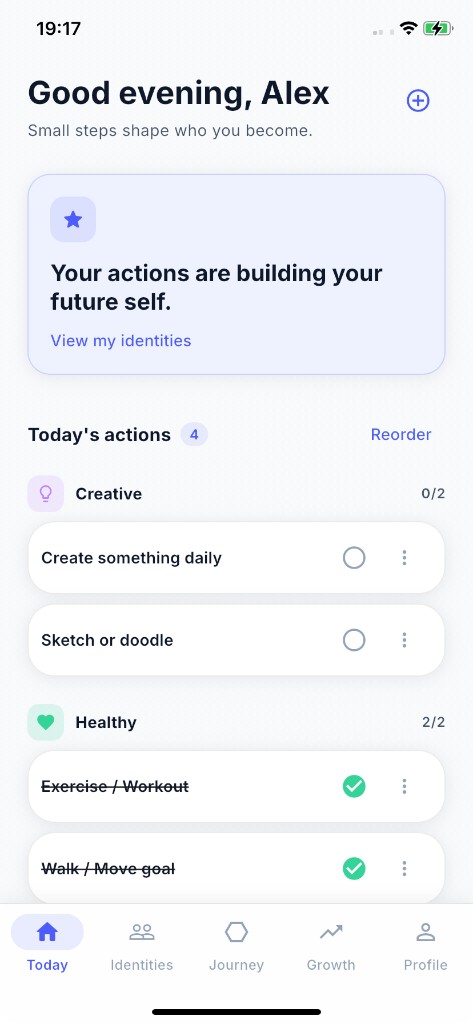
Ascend is not therapy, and it will not untangle deep trauma or clinical patterns on its own. What it can do is give sabotage less room to hide. When actions are tied to identities and reviewed weekly, the loop becomes visible earlier, while it is still small.
The identity quiz can also help if you are not sure which story you are actually protecting. Sometimes the sabotaged goal is not the real issue. The real issue is an older identity that still feels like home.
If you keep getting in your own way, stop asking only "Why am I like this?" Start asking "Which old identity am I still defending, and what tiny vote for the new one could I cast tomorrow?" That is a harder question, and a more useful one.
Professional support still matters when sabotage is tied to trauma, addiction, or clinical depression. Identity work runs alongside that support; it does not replace it. The goal here is clarity and structure, not a claim that insight alone fixes everything.
If sabotage keeps repeating in the same domain, shrink the stakes. Make the next action so small that the old identity has less reason to panic. You are not trying to prove a new self in one week. You are trying to make that self familiar enough to tolerate.
Over time, the question shifts from whether you can stop sabotaging to whether you can notice it sooner. Earlier noticing is progress, even when the behavior still happens occasionally.
You do not need to win every internal argument to change the pattern. You need to win enough of them that the new identity starts to feel like a real option, not a temporary performance.
FAQ
Do I self-sabotage because I am afraid of success?
Sometimes, but "fear of success" is usually shorthand for fear of identity change. Success means behaving like a different kind of person, and that can feel risky even when you want the outcome. Sabotage often restores the old, familiar identity.
How do I stop sabotaging myself without more willpower?
Shrink the action, name the hidden payoff of the old behavior, and collect small evidence for the identity you want. Willpower spikes fade. A believable identity built through repeated small votes is more stable.
Is Ascend free?
Ascend is free to download. Ascend Pro adds optional extras like unlimited identities and deeper insights via subscription.
Does my data leave my device?
Your identities, habits, and reviews are stored locally on your device by default.