
Life change, without the montage
Life change is a pile of ordinary days, not one extraordinary decision.
If you want to change your life, start by changing what you practice on boring Wednesdays. Everything else follows slower than Instagram suggests.
The fantasy of the single turning point
Most "change your life" content sells a moment: the resignation email, the breakup, the move abroad. Those moments happen. They are also rare, expensive, and easy to romanticise after the fact. For most people, life change is a slower accumulation of decisions that looked small at the time. The montage is marketing. The calendar is real. The montage is marketing and the calendar is real, which is why durable life change is a slower accumulation of decisions that looked insignificant when you made them on tired weekdays.
If you are waiting for a lightning bolt of clarity before you act, you may wait years. Clarity often follows action, not the other way around. You do not need to feel ready. You need a practice small enough to start tired. One vote today beats a perfect plan you never begin because conditions are never ideal. You do not need to feel ready; you need a practice small enough to start exhausted, because clarity often follows action rather than arriving like a lightning bolt you can wait for safely.
Turning points also get retold as if they were solo events. Usually other people helped, or timing broke your way, or you had been practicing small changes for months before the big decision looked sudden. Honest life change stories include the boring middle. That middle is where you are probably standing right now. Honest life change stories include the boring middle you are probably standing in now, where small votes compound long before any outsider would call what you are doing a transformation worth celebrating.
Change the identity, not just the outcome
Outcome goals ask "what do I want to have?" Identity asks "who do I want to become?" That shift sounds abstract until you use it on a normal day. A person who wants to "lose weight" might skip the gym when the scale disappoints. A person practicing being healthy might still walk after a bad week because that is what healthy people do more often than not. You are deciding which story gets the next chapter of daily evidence while keeping the old chapters intact, because reinvention is editing who you practice being, not erasing your past to feel clean.
Reinvention is editing who you practice being, not erasing your past. You are not deleting your history. You are deciding which story gets the next chapter of daily evidence. The old chapters still happened. They inform what you will not repeat and what you are willing to try differently this time. Identity survives setbacks better than outcomes, because you can miss a deadline and still be someone who ships work, whereas pass-fail goals collapse into shame the first time the scale disappoints you.
Identity also survives setbacks better than outcomes. You can miss a deadline and still be someone who ships work. You can have a bad month and still be someone who moves their body. Outcomes collapse into pass or fail. Identity accumulates a ratio over time, which is closer to how real life actually works. One lever well pulled beats five levers grabbed and dropped, especially when everything feels on fire and you need a platform habit that makes the rest of the week ten percent more manageable.
Choose one lever that touches everything
Trying to change your career, relationships, health, and finances simultaneously is how people burn out before anything sticks. Pick one lever that makes other changes easier. For some people that is sleep. For others it is movement, creative work, or financial tracking. One lever well pulled beats five levers grabbed and dropped. Ascend provides structure, not willpower, and if your environment is actively hostile to change you may still need to address that environment instead of optimizing a morning routine inside a burning building.
Ask which single practice would make the rest of your week feel ten percent more manageable. Not perfect. More manageable. That is often the right starting identity. Change feels impossible when everything is on fire. One stable habit creates a platform for the next edit without requiring a total life overhaul. Your worst week is the real test, not your best Sunday plan, so minimum versions exist to keep identity practice alive when motivation is gone and the old script offers fast relief with familiar regret.
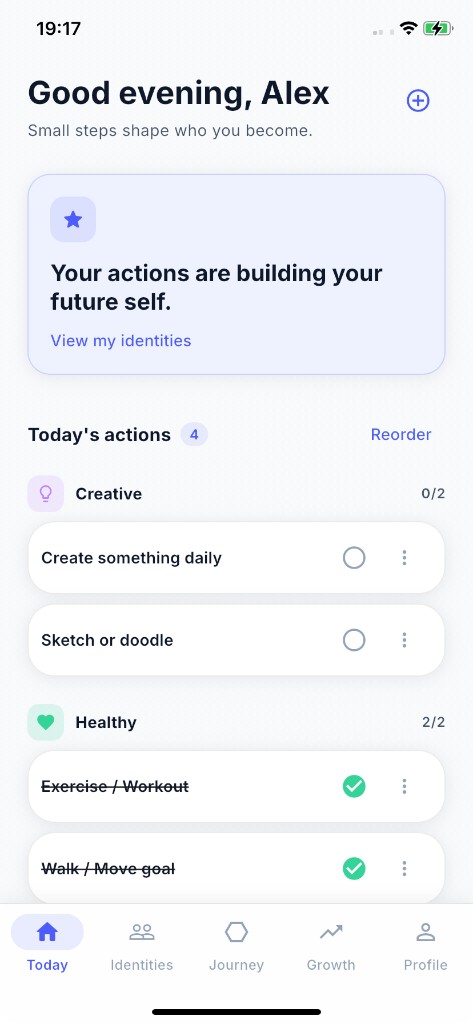
Ascend works best when you commit to one or two identities at a time. Import a starter plan, rename the habits to match your schedule, and resist the urge to optimise ten areas at once. The app provides structure, not willpower. If your environment is actively hostile to change, you may need to address that environment too. Write minimum versions before you need them, because decision fatigue on a hard day will otherwise shrink your ambition to zero and teach you, again, that change is not for people like you.
Ready to practice a different identity starting today?
Design for your worst week, not your best
Life change plans often assume your best self will show up daily. Real life includes sick kids, deadline weeks, grief, and plain old bad moods. If your plan only works on ideal days, it is not a life change plan. It is a vacation fantasy dressed up as discipline. Your worst week is the real test. Review is editing, not sentencing yourself for being human, and patterns show up at week scale that daily guilt hides, like weekend collapse or an identity starved while another one thrives loudly.
Build a minimum version of each habit. Five minutes of movement. One paragraph written. One honest line in a journal. Minimum versions keep identity practice alive when motivation is gone. That is usually when identity matters most, because the old script offers fast relief and familiar shame in equal measure. Ten minutes once a week beats an hour of nightly self-criticism, because life change becomes sustainable when you treat the plan as a draft that improves with data instead of a contract you pass or fail.
Write your minimum versions down before you need them. Decision fatigue on a hard day will otherwise shrink your ambition to zero. A plan that says "at least do the two-minute version" is a plan that survives contact with real life. Perfection is not the goal. Return speed is. Sometimes the life-changing move is leaving, getting treatment, or asking for help, not optimizing mornings while the building burns, and honesty about which problem you are solving keeps tools in the right lane.
Weekly review is where change becomes visible
Daily actions feel invisible until you zoom out. A weekly review answers a simple question: did my behavior match who I said I wanted to become? Not perfectly. Mostly. Sometimes. That question is kinder than a daily streak and more honest than a vague sense that you are trying. An app can log votes, but it cannot rewrite a situation that makes change impossible, so address structure first when safety, toxicity, or untreated crisis is the real bottleneck, not follow-through alone.
Patterns show up in review that daily guilt hides. Maybe you are consistent Monday through Thursday and collapse every weekend. Maybe one identity is thriving while another is starved. Adjust the plan based on evidence, not shame. Review is editing, not sentencing yourself for being human. The first vote matters because it breaks the trance that change requires a better version of you to arrive first, and one small action before bed is enough to begin collecting proof tonight.
Ten minutes once a week beats an hour of self-criticism every night. Look at what you actually did. Keep what worked. Shrink what did not. Life change becomes sustainable when you treat the plan as a draft that improves with data, not a contract you either pass or fail forever. Future you is built from ordinary days you almost skipped because they did not feel significant enough to count toward the life you say you want when nobody is watching your behavior.
When life change needs more than habits
Habit structure helps when you know the direction and struggle with follow-through. It helps less when you are in an unsafe relationship, a toxic workplace, or an untreated mental health crisis. Ascend is a habit and identity app, not therapy, not legal advice, and not an exit plan from danger. One missed vote is noise, but a pattern of never returning is the old identity winning by default, so design your start small enough that coming back after a gap still feels possible and humane.
If your situation requires professional support, get that support. Habits can still help on the other side. They are rarely the whole intervention when you are in acute pain. Sometimes the life-changing move is leaving, getting treatment, or asking for help, not optimizing your morning routine while the building burns. Turning points get retold as solo events, but small changes for months usually precede the big decision that later looks sudden to people who did not see your private practice.
Be honest about which problem you are solving. If the issue is follow-through on goals you already believe in, habit practice fits. If the issue is that your life is structurally unsafe or unsustainable, address structure first. An app can log votes. It cannot rewrite a situation that makes change impossible. Outcomes collapse into pass or fail, while identity accumulates a ratio over time that is closer to how real life actually works when you are editing, not erasing, who you practice being.
Start today with one vote
Pick one identity. Attach one action you can complete before bed. Do it. Log it if you use Ascend. Repeat tomorrow. That is unglamorous. It is also how lives actually change. The first vote matters because it breaks the trance that change requires a better version of you to arrive first. Ask which single practice would make the rest of your week feel ten percent more manageable, not perfect, because change feels impossible when everything is on fire at the same time.
You do not need a new personality by Friday. You need proof that you can practice being someone slightly different for one week, then another. The montage is fake. The repetition is real. Future you is built from ordinary days you almost skipped because they did not feel significant enough. If the issue is follow-through on goals you already believe in, habit practice fits; if the issue is structural danger, address structure first before you conclude that you lack discipline.
If you miss tomorrow, return the day after. One missed vote is noise. A pattern of never returning is the old identity winning by default. Life change is less about intensity and more about coming back. Start small enough that coming back feels possible even when you are embarrassed about the gap. Life change is less about intensity and more about coming back, so start small enough that returning after a miss still feels possible even when you are embarrassed about the gap.
FAQ
How long does it take to change your life?
Meaningful identity shifts usually show up over months, not days. You may feel small changes in four to six weeks of consistent practice. Larger life circumstances often take longer and may require decisions beyond habit tracking.
Do I need to change everything at once?
No. One identity and two or three small actions is enough to start. Overloading yourself is one of the most common reasons life change attempts fail within three weeks.
Is Ascend free?
Ascend is free to download. Ascend Pro adds optional extras like unlimited identities and deeper insights via subscription.
Does my data leave my device?
Your identities, habits, and reviews are stored locally on your device by default.