
Escape the drift loop
You are not lazy. You are drifting because your days have no anchor for who you meant to be.
Time waste is rarely empty staring. It is low-stakes activity that lets you avoid the identity risk of real work, real rest, or real connection.
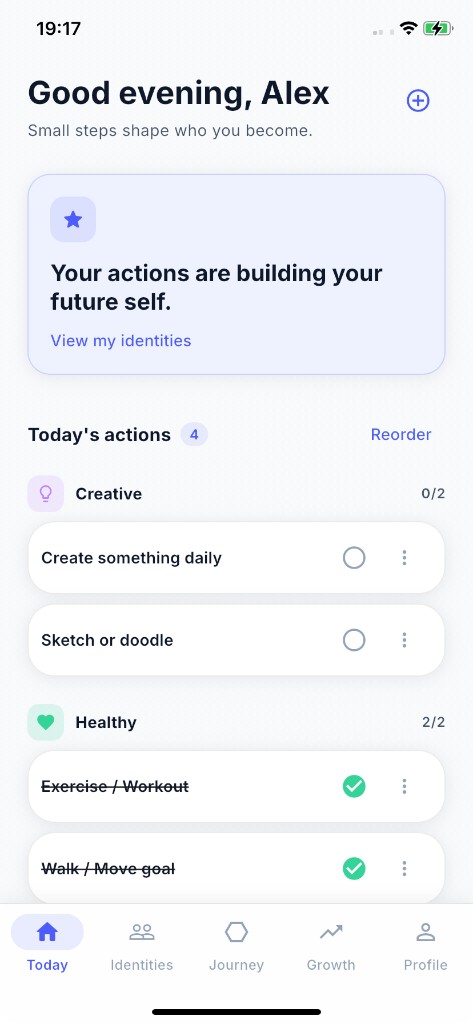
What wasting time actually looks like
You answer messages that could wait until tomorrow. You reorganize tools, folders, and tabs instead of shipping the thing that actually matters. You watch videos you do not care about because starting the real task feels heavy, ambiguous, or exposed to judgment. The day fills with motion that does not move anything forward, and you still feel tired at bedtime.
At the end of the day you wonder where the hours went. You were busy. You were not aligned. That gap between activity and progress is what people mean when they say they wasted time, even if you never sat still on the couch doing nothing. Busyness is often the disguise drift wears.
The problem is rarely that you love leisure. It is that leisure became camouflage for avoidance. Scrolling, tidying, low-stakes admin, and "quick checks" let you feel productive while the meaningful work stays untouched on your list. You might tell yourself you will start after one more thing. One more thing becomes the whole afternoon.
If you recognize yourself here, the fix is not a harsher schedule or another color-coded planner. It is seeing the loop clearly enough to practice a different identity on purpose. Time waste is a behavior pattern, not a personality sentence. That distinction is where change becomes possible.
The identity of the drifter
You practice the person who postpones what matters because failure feels safer than trying. Drift protects you from judgment. As long as you never fully commit, you never fully fail, and your ego stays intact behind a wall of half-started projects.
That protection has a cost. Weeks pass and the conversation, health habit, or creative work you care about stays theoretical. You are not lazy. You are risk-averse in a way that looks like laziness from the outside. Friends who ship more are not smarter. They often feel less exposed when they finish imperfect work.
Intentional and Productive are built through morning priorities, one completed priority before entertainment, and an evening review of where time actually went. Small proof, repeated, changes the story your brain tells about who you are on a Tuesday afternoon.
You are not broken. You are stuck in a loop that trades long-term meaning for short-term numbness. The loop can loosen when you stop fighting it with shame and start replacing it with evidence. Identity shifts when your days contain visible votes for the person you mean to be, not when you win a single heroic willpower battle.
Why time-blocking alone fails
Calendars full of blocks still get hijacked if your identity defaults to escape when anxiety rises. Structure without identity is a pretty schedule you ignore by noon. The blocks look responsible on Sunday night and irrelevant by the first unexpected email on Monday.
Color-coded hours do not address the moment you open Twitter because the report feels ambiguous. They do not address Sunday dread, the inbox you use to avoid creative risk, or the meeting hangover that sends you into passive scrolling for an hour. Time blocks assume you are the same person at 9am and 3pm. You are not.
Ascend does not track every minute. It tracks whether you did the small actions that prove you are intentional: three priorities written, one focus block, honest evening review. That is enough data to steer a week without turning your life into a spreadsheet you resent.
Willpower is finite. Proof is cumulative. A month of logged focus blocks beats a perfect planner you abandoned by Wednesday. The goal is not perfect adherence to a calendar. The goal is enough repeated evidence that drift is no longer your default setting.
Ready to practice a different identity starting today?
Morning anchors
Write three priorities before opening messages. Not twenty tasks. Three that would make today feel real if you finished only those. The constraint forces honesty about what actually matters versus what merely feels urgent because someone else asked.
Complete one priority before entertainment, even if it is twenty minutes of work. That vote matters more than a perfect eight-hour plan you never start. Morning proof tells afternoon-you that the day already contains alignment, which makes drift less tempting when energy dips.
If mornings are chaotic with kids, shift work, or caregiving, pick a five-minute version. One sentence of priority on a sticky note still counts. Chaos days still build identity when you anchor once. Perfect mornings are not required for intentional days.
Morning anchors work because they decide for future-you before drift has a chance to negotiate. You are not hoping motivation appears. You are placing a small flag that says this is who I am practicing today. That flag is often enough to interrupt autopilot before it starts.
Evening audit without cruelty
Ask where time actually went. Not to punish, to see drift patterns. Meetings? Scroll? Perfectionism? Helping everyone else while your work waits? The audit is detective work, not a courtroom. You are looking for design flaws, not character flaws.
Write three bullets: what aligned, what drifted, what one change would help tomorrow. The whole audit can take five minutes. Long guilt spirals are another form of time waste. Short honest review closes the loop so tomorrow starts with data instead of vague shame.
One focused twenty-five-minute block daily is enough to shift identity over a month. Log it in Ascend so you can see proof when your brain insists nothing changed. Memory lies after hard weeks. A simple track record shows direction even when individual days felt messy.
Weekly audit of time leaks turns vague guilt into one adjustment for next week. Adjust one habit, not your entire personality. Maybe you drift after lunch. Maybe you drift when tasks feel undefined. One lever at a time is how drifters become intentional people without burning out on reform.
Rest versus waste
Real rest is allowed. Watching a show on purpose is not the same as losing two hours to autopilot because you are avoiding sleep or feelings. Rest restores capacity. Waste spends capacity while pretending to restore it.
If you cannot rest without guilt, you will waste time anyway because burnout seeks numbness. Permission to rest well is part of productivity, not the enemy of it. People who never stop eventually stop through drift instead of choice, and drift feels worse than honest rest.
Practice Intentional leisure: choose it, enjoy it, stop when you said you would. The difference is agency. You are not performing discipline. You are proving you can enjoy something without letting it become camouflage for avoidance.
Drift feels like relief for ten minutes and emptiness for hours. Rest leaves you steadier. Learning the difference takes honest evening review. Over time you will feel the contrast in your body before the clock tells you. That felt sense is one of the best drift detectors you can build.
Ascend limitations
Ascend will not block YouTube or email. It will not force focus or close tabs for you. It gives identity-linked habits and weekly review so drift becomes visible instead of mysterious. Visibility is the first step toward choosing differently.
If wasting time is depression, ADHD, or burnout, structure helps alongside proper support. An app cannot diagnose why your capacity is low. Use the habits as scaffolding while you address the root cause with a clinician, therapist, or manager who can actually change your workload.
You can become someone whose days match priorities more often. Not every day. More days than last month is a win worth tracking. Progress is directional, not binary. The drifter identity loosens gradually when proof accumulates.
The goal is alignment you can see, not a performance of busyness for other people. Ascend is a mirror for identity practice, not a productivity scoreboard. If the structure helps you name the loop and act anyway on small priorities, it is doing its job.
FAQ
How do I know if I am resting or wasting time?
Rest leaves you steadier. Waste leaves you numb or ashamed. Intention is the difference. If you chose the activity and can stop without a fight, it is probably rest. If you slipped into it to avoid something, note that trigger.
What if my job wastes my time for me?
Meetings and bureaucracy are real. Control what you can outside work hours and small windows inside them. Morning priorities and one focus block still build proof that you are not only a drifter.
Is Ascend free?
Ascend is free to download. Ascend Pro adds optional extras like unlimited identities and deeper insights via subscription.
Does my data leave my device?
Your identities, habits, and reviews are stored locally on your device by default.