
Escape the revenge bedtime loop
Staying up late is often the only hour that feels yours. That is why mornings hurt.
Revenge bedtime procrastination is not weakness. It is a quiet bid for freedom after a day that owned you. The loop still steals tomorrow.
Why nights get longer
You finally have silence. No boss, no kids, no messages that need answers. Scrolling or streaming feels like reclaiming time even when it erases sleep. The hour after everyone else goes to bed feels like the only space that belongs to you. Email at 10pm can become scrolling at 11pm when the day never got an off ramp.
You know tomorrow will hurt. You stay up anyway. That is not stupidity. It is a relief loop. Revenge bedtime procrastination trades tomorrow's energy for tonight's sense of control. The choice for personal time is real even when the cost to tomorrow is also real.
The loop often starts after days with no unstructured peace. If every hour was scheduled, borrowed, or reactive, midnight becomes the stolen pocket where you finally choose something. Late nights sometimes start with one reasonable task that never ends. You might call it me time while knowing it costs next-day energy.
Naming revenge bedtime reduces shame enough to change it. You are not failing at adulthood. You are responding to a day that gave you obligations without autonomy. Change requires both nighttime boundaries and daytime freedom. Change needs daytime freedom and nighttime boundaries working together. Borrowed hours feel like freedom until tomorrow collects the debt.
The identity underneath
You practice the person who borrows from tomorrow because today offered no unstructured peace. Late nights become proof that you still have a self outside roles and responsibilities. Late nights become proof that you still exist outside roles and responsibilities.
Each extra episode or scroll session is a vote for that borrowed freedom. Enough votes and Well Rested feels like someone else's identity, not yours. That is the loop, not a character flaw. Morning regret alone rarely changes the loop without daytime adjustments.
Morning regret does not automatically change the loop. Without daytime adjustments, the same pressure returns tomorrow night. Identity shifts when you build proof on both sides of midnight. Both sides of midnight deserve attention, not only the alarm you hate.
You are not broken. You need daytime freedom and nighttime boundaries, not lectures. Well Rested and Disciplined are built through hard lights-out, wind-down routines, phone outside the bedroom, and weekly bedtime review. Small proof repeated changes who you are at 11pm more than guilt does. Small daytime freedoms reduce the urge to steal hours at midnight.
Why "just go to bed" fails
Telling a depleted person to sleep is like telling a hungry person not to eat. The nervous system wants stimulation or rest, and you chose stimulation because the day gave no off switch. Midnight arguments with yourself become their own stimulation.
Shame at midnight makes the loop worse. You stay up later arguing with yourself about why you are still up. The argument becomes its own stimulation. A depleted nervous system reaches for screens the way it reaches for sugar.
Partners who say "just come to bed" may mean well while missing the autonomy gap you are trying to fill. The fix is often shared planning for daytime breaks, not only a bedtime command. Ten minutes of real off-duty time after work can reduce the urge to steal hours.
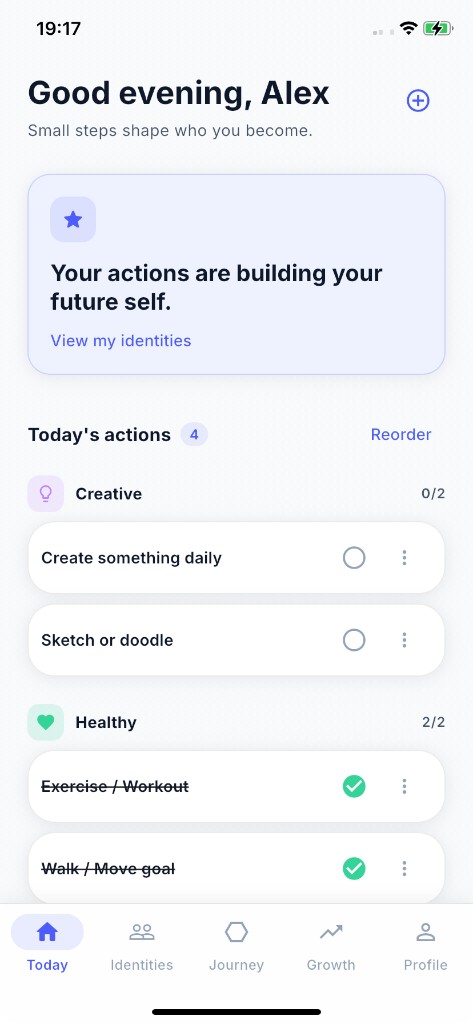
Ascend does not lock your phone at night. It structures habits and review so sleep becomes identity practice, not a battle with willpower at midnight. Fix evenings and afternoons together, not only the clock. Structure for tired people beats heroics for ideal people at midnight.
Ready to practice a different identity starting today?
Wind-down that actually happens
Thirty-minute wind-down: dim lights, same sequence nightly. Brush teeth, stretch, read paper, whatever is repeatable. Repeatability matters more than perfection. Sequence matters more than length if you will actually repeat it.
Hard lights-out time means a time, not a vibe. Choose one you can hit five nights a week. A realistic time practiced beats an ideal time abandoned. Caffeine after 2pm is chemistry, not a willpower failure at 11pm.
No caffeine after 2pm supports the identity you want at 11pm. Start the wind-down before you feel tired. Waiting until exhaustion often means skipping the routine and falling into a screen instead. Starting wind-down before exhaustion prevents skipping straight to a screen.
Pick a wind-down cue you enjoy enough to repeat. If the routine feels like punishment, revenge bedtime wins the argument at midnight. Log wind-down in Ascend even when imperfect. Log imperfect wind-downs anyway; three steps done beats a perfect routine abandoned.
Phone and bedroom boundaries
Phone charges outside the bedroom. Extreme? Effective for many scrollers. The bedroom stops being a portal to infinite content. Many scrollers need the bedroom to stop being a portal to infinite content.
If TV is your tool, set one episode, not "until tired." Tired arrives at 1am when autopilot is driving. A chosen stopping point is Disciplined proof, not deprivation. One episode is chosen stopping; until tired is autopilot driving past midnight.
Batch tomorrow's first task at night so morning does not feel like another theft of freedom. When morning looks manageable, bedtime feels less like surrender. Manageable mornings make bedtime feel less like surrender to tomorrow.
If you use your phone as an alarm, swap to a cheap clock. The alarm excuse keeps the scroll device in arm's reach all night. Tools support proof. Proof changes the loop. Grayscale and notification cuts support proof, but identity shifts with repeated practice.
Weekly bedtime consistency review
Review actual bedtimes, not intended ones. Patterns show whether late nights cluster after stress, loneliness, or good TV. Intended bedtime is a wish. Actual bedtime is the identity data. Actual bedtime is identity data; intended bedtime is often a wish.
Adjust one variable: earlier wind-down, social plans that end on time, daytime break that is truly off duty. One lever at a time keeps change sustainable. Apology without review is its own loop that keeps late nights invisible.
Notice whether you apologize each morning without changing anything. Apology without review is another loop. Ascend's review tracks whether you practiced Well Rested or only narrated regret. Busy seasons need stricter wind-down; calm seasons can test small daytime freedoms.
Seasonal stress deserves seasonal plans. Busy project weeks need stricter wind-down. Compare sleep quality to bedtime drift. Sometimes the issue is not "late" but "wired." Sometimes the issue is wired, not late; change wind-down content, not only the clock.
Limits
Ascend is not a sleep clinic. Insomnia, sleep apnea, or mental health drivers need professional care. Habit structure helps lifestyle loops alongside treatment, not instead of it. Habit structure helps lifestyle loops alongside treatment, not instead of it.
The app will not disable your router or lock your devices. It offers identity structure for people whose late nights are habit loops, not only medical conditions. Know which problem you are solving. Know whether you are solving a medical issue, a schedule issue, or a habit loop.
It will not create daytime autonomy for you. If your job or caregiving load leaves no breathing room, you may need boundary conversations outside the app. Night shift workers need different proof than nine-to-five advice assumes. Unsustainable jobs may need boundary talks the app cannot replace.
You can reclaim daytime freedom slowly while protecting sleep. Both matter. Progress is more nights near your lights-out time and more minutes of real off-duty time before 10pm, tracked over weeks. Progress can be fifteen extra minutes of sleep before midnight, logged honestly. Even fifteen extra minutes of sleep before midnight is progress worth logging.
FAQ
What is revenge bedtime procrastination?
It is staying up late to gain personal time after a day with little autonomy, even when you are tired. Recognizing it helps you add small freedoms earlier in the day instead of paying with sleep.
How long should a wind-down routine be?
Twenty to thirty minutes is enough for many people if it is consistent. The sequence matters more than the length. Start with three repeatable steps you will actually do.
Is Ascend free?
Ascend is free to download. Ascend Pro adds optional extras like unlimited identities and deeper insights via subscription.
Does my data leave my device?
Your identities, habits, and reviews are stored locally on your device by default.