
When enthusiasm fades fast
Motivation was never meant to carry a habit alone.
If your motivation disappears as soon as the novelty wears off, that is not a personal defect. It is what motivation does when habits are built on excitement instead of identity.
The motivation curve is predictable
New goals feel electric for a few days. You tell friends, buy supplies, imagine the future version of you who has already won. Then the feeling softens. The goal is still there, but the spark is gone. Within a week or two, doing the thing requires effort instead of inspiration.
Most people treat that drop as a character flaw. "I lose motivation too quickly." In reality, motivation is designed to spike around change and then settle. Expecting it to stay high is like expecting adrenaline to last all month.
Consistency problems are usually identity problems in disguise. Motivation fades quickly when the habit has no identity underneath it. You were excited about an outcome, not practicing a self.
Social media makes this worse by showing highlight reels of other people staying motivated. You compare your inner experience to their edited output and conclude you are uniquely weak. You are not. You are comparing mood to marketing.
Another motivation killer is vague success. If you cannot describe what a good week looks like in concrete actions, every flat day feels like failure. Identity gives you a simpler scorecard: did I practice the kind of person I said I was building?
Outcomes burn bright and burn out
Outcome goals are especially vulnerable to fast motivation loss. Lose ten pounds. Finish the course. Launch the project. Outcomes have finish lines, and finish lines create a subconscious countdown. Once the initial burst passes, the outcome can feel far away, abstract, or already compromised by one bad day.
Identity goals behave differently. "I am someone who trains" does not expire when the scale stalls. "I am a learner" still makes sense after a boring chapter. The action remains meaningful even when the feeling does not.
If your motivation collapses the moment progress slows, check whether you were chasing a result or practicing a person.
Outcome goals also invite cheating the metric or moving the goalpost. Identity goals are harder to fake because they show up in behavior across contexts, not just on the day you weigh in or present the project.
Novelty is doing more work than you think
A lot of early motivation is just novelty. New app, new notebook, new plan, new identity label on a whiteboard. Novelty is a legitimate starter fuel. It is a terrible long-term engine.
When novelty fades, habits that were never properly sized or anchored start to feel heavy. That is the moment people say they "lost motivation," when what they really lost was the cheap energy of something new.
The fix is not to chase endless novelty. It is to make the habit small enough and identity-linked enough to survive the boring middle, when nothing feels special about showing up.
If you rely on novelty, you will keep restarting instead of deepening. New planner, new app, new challenge. Each restart gives you another hit of day-one energy without building the boring middle where real change lives.
Invisible progress kills momentum
Motivation also drops when you cannot see evidence of progress. You ate better for ten days but the mirror looks the same. You studied consistently but the exam is still months away. You wrote every morning but the draft still feels rough.
Without visible proof, the brain assumes the effort is pointless. That assumption is often wrong, but it is persuasive in the moment.
Identity-based tracking helps because it measures alignment, not only outcomes. Did I act like the person I am trying to become today? That question can be answered even when external results lag. Evidence keeps motivation from free-falling while the bigger change catches up.
This is especially true for habits with delayed payoffs: fitness, language learning, creative work, financial discipline. The identity frame helps because it gives you something to measure before the external results arrive.
Too many goals dilute all of them
Motivation disappears faster when it is split across too many priorities. Ten habits, five identities, three life overhauls at once. Each one gets a thin slice of attention, and none of them build enough repetition to feel real.
The result is a constant sense of starting without ever landing. Every day feels like day three. That is exhausting, and exhaustion reads as "I have no motivation."
Narrowing helps more than pep talks. One or two identities, a handful of small actions, and a weekly review to see whether your limited energy is actually going where you say it should.
Saying no is part of motivation management. Every identity you add splits your attention. Consistency often returns when you stop pretending you can overhaul five areas of life with the same limited willpower reserve.
Motivation also returns when progress becomes legible. If you only measure outcomes, you will feel behind for months. If you measure aligned actions, you can see yourself practicing the identity even when the outcome lag makes you doubt the whole project.
Systems outlast moods
People who look motivated from the outside are often just well structured. They decided in advance what a small aligned action looks like, made it easy to start, and built a weekly check-in so drift gets caught early.
That is less glamorous than a inspiration surge, but it is more reliable. Systems do not require you to feel ready. They require you to know what the next small vote looks like.
A weekly review is especially important here. It turns a vague sense of "I fell off" into a pattern you can adjust before motivation becomes the excuse instead of the symptom.
A good system also reduces decision fatigue. You do not renegotiate the walk every morning. You know what the identity requires, what counts, and when you will review it. Fewer decisions means fewer chances for the old self to win the argument.
Pair the system with a default. If the morning is chaotic, the default is the smallest version of the action, not zero. Defaults protect motivation on the days when you cannot generate it from scratch.
What to do when the spark is gone
When motivation drops, do not wait to feel inspired again. Shrink the action until it is almost embarrassingly small. Open the document. Put on shoes. Read one page. Cast one vote for the identity, even if the vote feels weak.
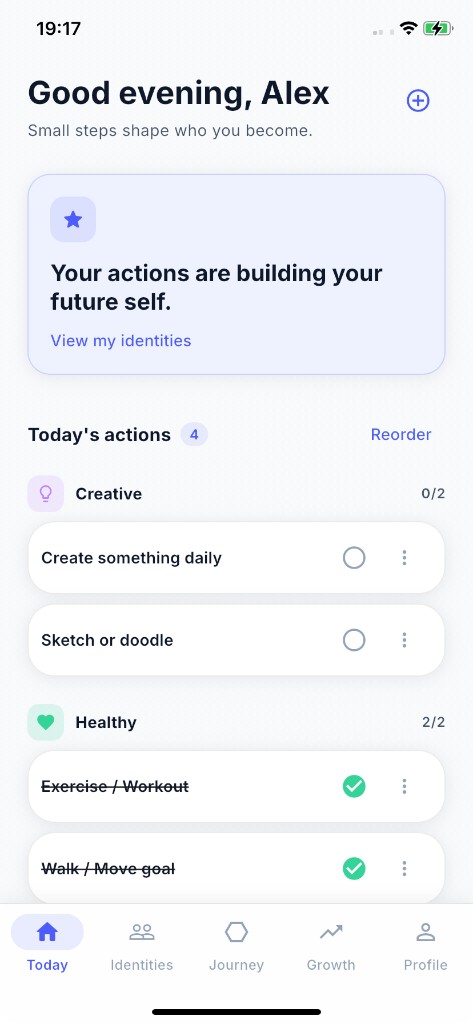
Ascend is built for that middle period, when enthusiasm is gone but the direction still matters. It keeps identities and actions visible, tracks alignment over time, and uses weekly review to show proof that the boring days still count.
Motivation will come and go. Identity, practiced in small repeatable actions, is what keeps you from interpreting every quiet week as proof that you should quit.
Treat low-motivation days as the real test. High-motivation days almost anyone can perform. The identity is built on the days when you would rather not, but still cast a small vote anyway.
It also helps to separate energy from direction. You can be tired and still aligned. Alignment does not require enthusiasm. It requires a small action that matches the identity, even when the action feels flat.
When the spark is gone, protect the minimum version of the habit before you protect the mood. Mood is weather. Identity practice is climate. You are building climate.
If you wait to feel motivated before you act, motivation stays in charge. If you act in small ways first, motivation sometimes follows. Not always, but often enough to matter over a month.
FAQ
Is it normal to lose motivation after a week or two?
Yes. Early motivation is often fueled by novelty and optimism, both of which fade. The problem is not the fade itself. It is building a habit that only works while motivation is high.
How do I stay consistent when I never feel motivated?
Shrink the action, tie it to a clear identity, and review weekly so you can see alignment even when feelings are flat. Consistency grows from structure and evidence more than from inspiration.
Is Ascend free?
Ascend is free to download. Ascend Pro adds optional extras like unlimited identities and deeper insights via subscription.
Does my data leave my device?
Your identities, habits, and reviews are stored locally on your device by default.