
Escape the scroll loop
You are not weak. You are stuck in a scroll loop that feels like relief.
Doomscrolling is not a character flaw. It is a habit your brain learned when the feed was the fastest way to feel something, anything, at the end of a long day.
What doomscrolling actually is
Doomscrolling usually starts innocently. You pick up your phone to check one thing, and twenty minutes later you are reading headlines, comments, or videos you did not plan to open. The content is often negative, but stopping feels harder than continuing. Most advice treats this as a discipline problem. Delete the app, set a timer, turn on grayscale.
Those tools can help for a day or two. Then you are back at 11pm on the couch, thumb moving on its own while you tell yourself you will stop after this one thread. The pattern is not random. Your brain has paired the phone with a reliable short hit of stimulation. That pairing is the habit.
The feed is just the delivery mechanism. You might notice it most on Sunday nights, during a slow afternoon at work, or in the ten minutes after a tense text from someone you care about. The scroll fills a gap that feels too small to matter until an hour is gone. You may tell yourself you are staying informed. Sometimes that is true.
Often you are medicating uncertainty with headlines that confirm the world is as scary as you already feel. The scroll also steals transitions. You never fully arrive home, never fully land in bed, never fully finish the thought you were having before you picked up the phone.
The identity loop underneath
You are not broken. You are practicing being someone who copes by scrolling. Maybe that identity showed up during a stressful job, a lonely stretch, or years of checking news before bed. The scroll became proof that you are informed, connected, or simply awake enough to keep going. Identity-based habits work both ways.
Every time you open the feed when you feel restless, you cast a vote for the person who scrolls when things get uncomfortable. That vote is small, but it compounds. After enough evenings, scrolling is not a choice. It is who you are in that moment. Change starts when you name the loop honestly.
Not "I am addicted to my phone," but "I reach for my phone when I do not want to feel what I am feeling." That reframe matters because it points toward a different kind of fix than shame. The relief is real for a few minutes. Your shoulders drop. You feel briefly caught up. Then the feeling you avoided is still there, plus fatigue and a vague sense that you wasted the evening again.
Friends who scroll less are not morally superior. They often have different routines, different jobs, or different nervous systems. Comparison feeds the shame that makes the loop stronger. When you catch yourself mid-scroll and feel nothing but numbness, that is useful data. Numbness is often the feeling you were avoiding in the first place.
Why willpower fails at night
Willpower is lowest when doomscrolling is highest. After work, after parenting, after a hard conversation, your prefrontal cortex is tired. The feed does not ask anything of you. It meets you exactly where you are. Blocking apps can create a game of whitelists and workarounds.
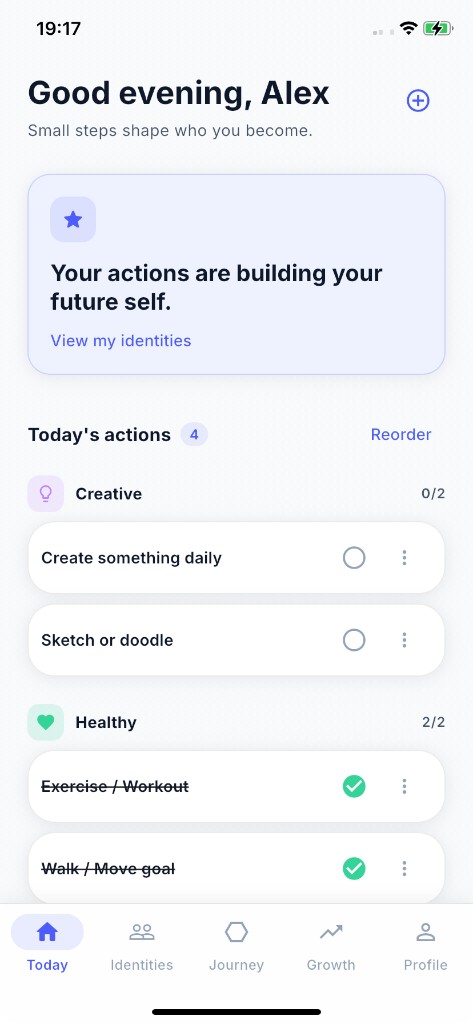
Ascend does not block anything. It gives you a structure for the identity you want instead: someone present in the morning, intentional about one scroll session, honest in a weekly review. Structure beats white-knuckling when you are exhausted. If your only plan is "try harder," you will lose on the nights that matter most. You need replacement proof, not just removal.
At 10:30pm your brain is not interested in your morning self's promises. It wants the fastest exit from the day. Fighting that with guilt at midnight is a fight you have already lost a hundred times. Night-you and morning-you are not the same person with the same priorities. Planning only for morning-you guarantees failure at 10pm when the feed is right there.
Replacement proof can be tiny. Water. Three breaths. One page of a book you already started. The bar is low because the goal is interrupting autopilot, not building a new life in one evening.
Ready to practice a different identity starting today?
Triggers you can actually map
Most people doomscroll in predictable windows. The first ten minutes after waking. The commute home. The gap between dinner and sleep. Boredom on the sofa. Anxiety before a meeting. Map yours for three days without judging them.
Triggers are not excuses. They are design specs. If you always scroll in bed, the habit is tied to bed, not just phone. Moving the charger across the room is boring advice because it works. Pair it with one morning action that proves you are someone who starts the day on purpose. Write down the feeling right before you open the app. Bored.
Lonely. Overwhelmed. That label is more useful than counting screen time minutes. Notice whether you scroll more after poor sleep, skipped lunch, or a day full of meetings where you never had a real break. Stacked triggers are common. Fixing one layer can reduce the whole loop. Keep a notes app entry for three days: time, place, feeling before scroll.
You will see repeats faster than you expect. Wednesday 9pm on the couch after takeout is a pattern, not a coincidence. If your trigger is post-work decompression, build a five-minute ritual before the phone is allowed. Shoes off, shower, tea. Sequence matters more than duration.
Small votes for a different identity
Pick two or three daily actions small enough to do on a bad day. Phone-free for the first thirty minutes after waking. One timed scroll session instead of six accidental ones. Phone docked outside the bedroom at night. These are not punishments. They are evidence.
In Ascend, those actions attach to identities like Present or Intentional. Checking them off is not about perfection. It is about noticing whether your day matched who you said you wanted to be. On days you scroll anyway, log it without a lecture. A missed action is data, not a verdict. The goal is a track record over weeks, not a guilt-free streak.
A timed fifteen-minute scroll at 7pm is different from six accidental sessions between 6pm and midnight. The first is a choice. The second is autopilot. Both can coexist while you build proof. Share one habit with someone you live with if you can. "I am trying phone-free mornings" is easier to keep when another person notices you doing it.
Perfection is not the metric. Three phone-free mornings out of seven is progress if last month you had zero. Track direction, not streaks.
Weekly review without the shame spiral
Doomscrolling thrives in amnesia. You scroll, feel bad, promise to change, forget by Thursday, repeat. A five-minute weekly review breaks that cycle. Look at which days you honored your phone-free windows and which days you did not. Ask one question: what was happening on the days you slipped? Late meetings?
Poor sleep? Fighting with your partner? Patterns beat self-blame. Adjust one habit, not your entire personality. Ascend's weekly review is built for this. It is not a report card.
Bring the review down to one sentence if five minutes feels like too much: "What triggered my worst scroll day this week?" Answer honestly. Change one thing. Monthly patterns matter too. Stressful project weeks, election seasons, lonely winters. Seasonal triggers deserve seasonal plans, not generic guilt.
What Ascend will and will not do
Ascend will not block Instagram, TikTok, or news apps. It will not shame you with red screen-time numbers. It offers identities, daily actions, and a weekly pause so you can build proof that you are someone who can put the phone down. That is enough for many people. It is not magic.
If scrolling is masking depression, grief, or something you need professional support for, use the structure alongside real help, not instead of it. You are allowed to want relief and to choose a slower kind. The scroll loop learned itself over time. A different identity learns the same way, one small evening at a time. The app provides structure, not willpower.
It cannot make the feed less addictive or your day less exhausting. It can help you see whether you are practicing the person you mean to be when the phone is in your hand. If you need blocking tools, use them. Ascend still helps you track whether your days match the identity you chose. Blockers and structure solve different parts of the problem.
Progress looks like catching yourself ten minutes in instead of an hour in. That gap widens over months. Give it time without declaring failure every hard night.
FAQ
How long does it take to stop doomscrolling?
There is no fixed timeline. Most people see clearer patterns within two to three weeks of tracking triggers and doing small replacement habits. The goal is fewer automatic nights, not zero phone use forever.
Do I need to delete social media apps?
Not necessarily. Many people keep the apps and change when and how they open them. Timed sessions, morning phone-free windows, and weekly reviews often work better than deletion followed by reinstalling a week later.
Is Ascend free?
Ascend is free to download. Ascend Pro adds optional extras like unlimited identities and deeper insights via subscription.
Does my data leave my device?
Your identities, habits, and reviews are stored locally on your device by default.