
When good weeks keep disappearing
Consistency is not a personality trait. It is a design problem.
If you can be consistent in bursts but not over time, you probably do not need more guilt. You need a clearer identity, smaller actions, and a way to see the pattern before it collapses.
You have been consistent before. Just not steadily.
Most people who say they cannot stay consistent are not describing total chaos. They are describing a repeating shape: a strong week, a decent week, a slip, a restart, another slip. The problem is not zero effort. It is unstable effort.
That shape gets misread as lack of discipline. More often it means the system only works under ideal conditions. High energy, low stress, empty calendar, good sleep. Real life is rarely that generous.
Consistency problems are usually identity problems in disguise. Burst consistency happens when behavior is powered by mood. Stable consistency happens when behavior is tied to identity and sized for ordinary days.
Look closely at your bursts of consistency. They often share conditions: a clear deadline, social accountability, a new relationship, or a season when life was unusually quiet. Those clues tell you what your steady-state system is missing.
Steady consistency usually needs fewer moving parts than burst consistency. One identity, one review day, one minimum action. Remove the conditions that only appear during a motivational spike and keep the ones that can exist on an average Wednesday.
Consistency fails when the action is too big
An action that requires perfect conditions is not a habit. It is a performance. One hour workouts, elaborate morning routines, and all-or-nothing nutrition plans create short impressive runs followed by long quiet gaps.
When the action is too large, consistency becomes binary. You either did the whole thing or you failed. Failed days stack into abandonment because the system offers no graceful middle.
Durable consistency is usually boring on purpose. Small enough to do tired. Specific enough to count. Attached to an identity clear enough that a partial day still feels like practice, not defeat.
If you would not assign the habit to a tired friend you care about, it is probably too big for you too. Compassionate sizing is not lowering standards. It is building a standard you can actually repeat.
Consistency also improves when the action has a fixed slot. Same time, same cue, same minimum version. Uncertainty burns willpower before the habit even starts because you are negotiating from scratch every day.
Invisible rules make every miss feel final
Many people carry hidden rules without realizing it. If I miss twice, I have ruined it. If the week is already bad, I will start again Monday. If I cannot do the full version, there is no point doing any version.
Those rules sound like standards. They function like traps. They turn ordinary inconsistency into a reason to stop entirely.
A healthier rule is smaller and quieter: missing is data, returning is the habit. That rule belongs to an identity focused on alignment over time, not perfection on demand.
Write the hidden rules down. If I miss once, the week is ruined. If I cannot do the full workout, it does not count. Seeing them on paper makes it easier to replace them with rules that favor returning.
Then write the replacement rule in plain language: one miss is one miss, not a verdict. The identity is built from the average, not from the worst day. That sounds soft until you realize it is the only rule that survives real life.
You cannot stay consistent with ten priorities
Another common trap is trying to stay consistent across too many domains at once. Health, work, learning, relationships, creativity, admin, all elevated simultaneously. The result is constant partial consistency everywhere and durable consistency nowhere.
Your week has a finite amount of follow-through. Without prioritization, the identities that matter most compete with identities that merely sound good.
Choosing one or two active identities is not giving up. It is concentrating enough repetition in one place for consistency to become believable.
Consistency requires sacrifice. Not everything can be primary. Choosing one identity for this season is not quitting on the others forever. It is giving one story enough repetitions to become real.
Streaks confuse performance with identity
Streak-based apps can help briefly, but they often undermine long-term consistency. They teach you that the chain is the point. Real life breaks chains. Travel, illness, family emergencies, and plain bad moods all happen.
If your consistency depends on an unbroken streak, any interruption becomes existential. That is a brittle model of change.
Identity-based consistency asks a better question after a miss: did I return? Tracking alignment weekly makes returning normal instead of shameful.
A streak measures continuity. Alignment measures direction. You can break a streak and still be aligned with who you are becoming. That distinction saves a lot of people from quitting entirely.
Weekly review is the consistency engine
Daily action supplies the votes. Weekly review supplies the memory. Without review, you forget that you were actually consistent for eleven days last month, or that weekends are your real leak, or that one identity is getting all your energy while another is starving.
That blindness makes every new attempt feel like starting from zero. It is not zero. You just cannot see the pattern.
Consistency improves when the pattern is reviewed before it fully collapses. Five minutes once a week can be the difference between a wobble and a quit.
Review also helps you spot false consistency: busy days full of urgent tasks that never touched the identity you care about. Activity is not the same as alignment.
What helps you stay in the game
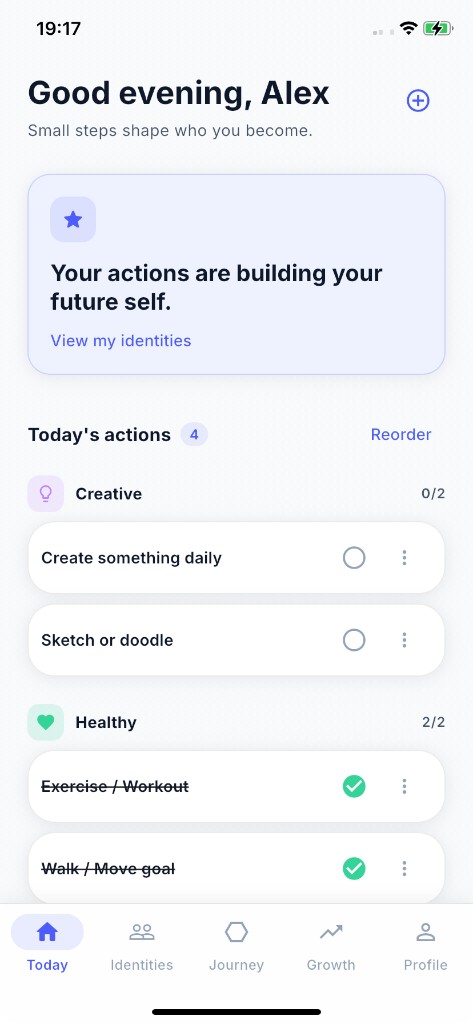
Ascend is designed around that loop: identity, small daily actions, weekly review. It will not make life less busy, and it cannot manufacture conviction where none exists. It can keep the practice visible and make alignment measurable when motivation is uneven.
If you cannot stay consistent, resist the urge to solve it with a bigger plan. Go smaller, choose a clearer identity, and review the week honestly. Consistency is usually built from returns, not from flawless runs.
The identity quiz can help if you are not sure which identity deserves your limited consistency right now. One clear priority beats five vague ones every time.
Consistency is often rebuilt through smaller promises kept, not bigger promises made. Promise less. Return faster. Review weekly. The personality trait version of consistency is a myth. The design version is learnable.
Track returns, not only streaks. How quickly do you come back after a miss? That number matters more than whether you were perfect. A person who returns within a day is practicing consistency even if the week looked messy.
Consistency is less about never wobbling and more about wobbling without quitting the identity. That distinction is the difference between a bad week and an abandoned year.
Build a minimum version for travel weeks, sick days, and chaotic seasons. The identity survives when the action shrinks instead of disappearing. Disappearing is what teaches you that you were never serious.
Protect one review day each week even when the daily actions are messy. The review is often what keeps consistency alive when life makes perfection impossible.
If you can return once, you can build consistency. Returning is the whole skill at first.
Do not confuse a messy week with a failed identity. Look at the average, then adjust the action.
Consistency grows when the system is kinder than your inner critic. The review should inform the next week, not indict your character.
Stay consistent with the identity, not with a fantasy version of your schedule.
A realistic schedule repeated beats a perfect schedule abandoned.
That is the whole game for most people trying to stay consistent in real life.
FAQ
Why am I consistent for a while and then fall off?
Burst consistency often means your plan only works under ideal conditions or depends on streak pressure. When life interrupts the ideal conditions or breaks the streak, the system collapses because it was never tied to a flexible identity practice.
What is the simplest way to become more consistent?
Pick one identity, define a small daily action you can do on a bad day, and review weekly so misses become adjustments instead of endings. Consistency grows from returns and visible proof.
Is Ascend free?
Ascend is free to download. Ascend Pro adds optional extras like unlimited identities and deeper insights via subscription.
Does my data leave my device?
Your identities, habits, and reviews are stored locally on your device by default.