
When consistency keeps slipping
Sticking to habits is rarely a discipline problem.
If you keep starting habits and quietly abandoning them, the issue is usually not that you lack willpower. It is that the habit was never tied to an identity you actually believe you are becoming.
The two-week pattern is familiar for a reason
You download an app, pick three habits, and feel genuinely motivated for about ten days. Then something normal happens: a late night, a stressful week at work, a weekend where the routine falls apart. By day fifteen, opening the app feels like evidence of failure instead of a helpful nudge.
Most people interpret that pattern as proof they cannot stick to anything. That interpretation is usually wrong. What actually broke was not your discipline. It was the connection between the habit and who you think you are. Without that connection, every missed day feels like the end of the story instead of one ordinary day in a longer one.
Consistency problems are usually identity problems in disguise. The habit was a task on a list. It was never a vote for a person you are actively trying to become.
The frustrating part is how repeatable the cycle is. January, September, the Monday after a holiday, the week after a breakup. Different triggers, same ending. That repetition is a signal, not a character flaw. The system you are using was built for day-one excitement, not for a normal Thursday when you are tired and behind on email.
Willpower runs out faster than identity
Willpower is useful in short bursts. It gets you through the awkward first week of waking up earlier or saying no to the snack cupboard at 10pm. It is a terrible long-term strategy because it depends on how you feel on any given Tuesday.
Identity works differently. A person who trains does not need a motivational speech before a short walk. A reader does not negotiate with themselves about whether ten pages count. The action follows from the story you are already telling about yourself, even when motivation is low.
If your habits keep dying when life gets busy, ask a different question than "How do I force myself to care?" Ask "Who would someone like me do this for?" If you cannot answer that clearly, the habit was always going to be fragile.
This is why two people can face the same habit with opposite results. One person treats it as a moral test they are failing. The other treats it as evidence collection for a role they are growing into. Same action, different frame, very different staying power over six months.
Borrowed habits break on contact with your real life
A lot of habit advice is copy-paste. Wake at 5am because a podcast host does. Meditate because a founder tweets about it. Track water intake because the template in the app suggested it. None of that is wrong on its own. It just is not yours until it connects to something you actually want to practice being.
Borrowed habits feel exciting at first because novelty is stimulating. They fail later because they have no personal anchor. When the novelty fades, you are left maintaining someone else's routine with your own limited energy.
Habits that stick tend to be small, specific, and clearly tied to an identity you chose on purpose. Not ten identities. One or two that matter right now, with actions sized for your worst week, not your best one.
If a habit keeps dying after you copy it from someone else, ask what identity it was serving for them. A CEO morning routine might support an identity around leadership and focus. For you, the same routine might just be noise before school drop-off. The action is not wrong. The fit is.
Streaks reward the wrong kind of consistency
Many habit trackers treat consistency as an unbroken chain of checkmarks. That works until you miss a day. Then the app becomes a record of failure, and quitting the app feels easier than facing the broken streak.
That design accidentally teaches you that habits are all-or-nothing. Real life is not all-or-nothing. Parents miss workouts. Students miss study blocks. People who care about their health still have weeks where everything slides. The question is not whether you are perfect. It is whether you are still practicing the identity on average.
If your tracker only celebrates unbroken streaks, it is measuring the wrong thing. Alignment over time matters more than a red X on Thursday.
There is a quieter form of consistency that never makes it into screenshots: showing up four days out of seven for three months. That pattern changes lives. Streak culture ignores it because it is not dramatic enough, then wonders why people quit after the first broken chain.
Small proof beats ambitious plans
One reason habits do not stick is that they start too big. An hour at the gym every day. An elaborate morning routine. A complete life overhaul on January 1st. Big plans create big friction, and big friction creates early abandonment.
Identity-based habits start smaller on purpose. Ten minutes. One page. One walk. One honest weekly review. The point is not to impress anyone. The point is to collect evidence that you are already becoming someone, even in modest doses.
That evidence compounds quietly. Three weeks of small walks is more useful than one heroic week followed by three months of nothing, because the story shifts from "I tried and failed" to "I am someone who mostly moves."
Ambitious plans also create a weird identity trap. If you only count the big version, you never get to practice being someone who does the thing at all. The beginner identity needs beginner evidence. Ten minutes counts. One page counts. They are not consolation prizes. They are how belief starts.
Weekly review is where sticking actually happens
Daily tracking alone rarely fixes a sticking problem. You need a slightly wider lens. Once a week, look back and ask which actions matched the identity you said you were building and which ones did not. Not to punish yourself. To notice patterns before another month disappears the same way.
Maybe you are consistent Monday through Wednesday and fall apart on weekends. Maybe one identity is thriving while another has gone quiet. Maybe the action is too big, poorly timed, or attached to an identity you like in theory but do not actually prioritize. Those are fixable problems. They are hard to see without a weekly pause.
Sticking to habits is less about never missing and more about returning without drama. The weekly review is where that return gets planned instead of hoped for.
Without review, every restart feels like starting from zero even when it is not. You forget the eleven decent days because the two bad ones were louder. Review restores proportion. It lets you adjust the action before you adjust your opinion of yourself.
What actually helps (and what does not)
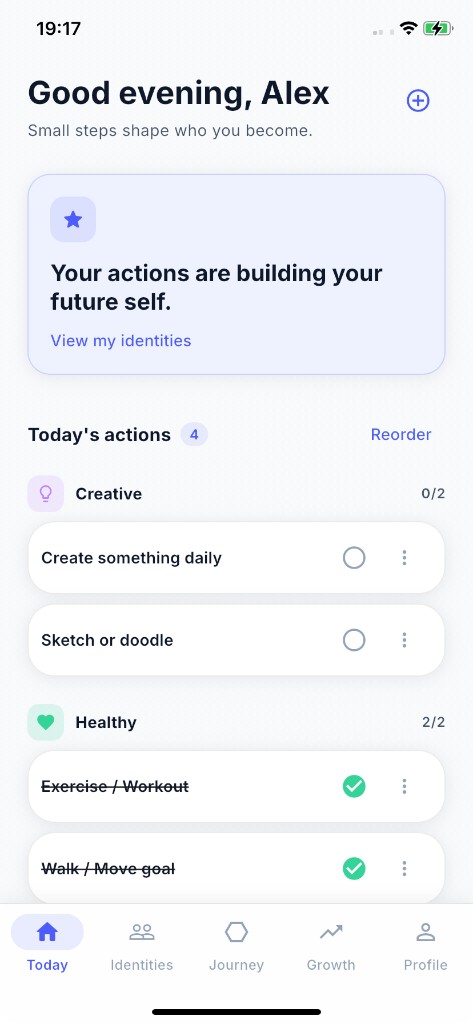
No app can make you care about an identity you have not chosen. What a good structure can do is keep the identity visible, keep the actions small, and keep the review honest. That is the gap Ascend is trying to fill: not motivation by notification, but a simple loop of identity, daily actions, and weekly reflection.
Ascend will not block distractions, automate your schedule, or tell you which identity to pick. It will help you practice one you already care about with less friction and clearer feedback over time.
If you keep asking why you cannot stick to habits, start by naming who the habits were supposed to make you. If that person is still vague, fix that first. The habits will get easier to keep once they have someone to belong to.
If you have tried habit apps before and abandoned them, that does not mean apps do not work for you. It may mean they were tracking tasks without helping you choose and practice an identity. Structure only helps once the identity is clear enough to care about.
FAQ
Why do I stick to habits for two weeks and then quit?
The first two weeks are often fueled by novelty and optimism, not identity. Once normal life returns, habits that are not tied to a clear sense of who you are becoming feel optional. That is why the drop-off is so predictable: the behavior was never anchored to a story about yourself.
Is the problem really identity and not discipline?
Discipline still matters, but it is a limited resource. Identity gives you a reason to return after a missed day without treating the miss as total failure. If you only rely on willpower, every hard week becomes a reason to quit.
Is Ascend free?
Ascend is free to download. Ascend Pro adds optional extras like unlimited identities and deeper insights via subscription.
Does my data leave my device?
Your identities, habits, and reviews are stored locally on your device by default.