
When the old self keeps winning
Change is hard because identity changes slower than intentions.
You can decide to change in a single afternoon. Becoming someone different takes repeated evidence. That gap is why change feels harder than it looks in motivational posts.
Intentions change overnight. Identity does not.
You can decide on Sunday night that this week will be different. New sleep schedule, better food, more focus, less phone, more exercise. The intention is sincere. By Thursday, most of it has dissolved back into the older version of your week.
That collapse feels discouraging because we are taught to treat change like a switch. In practice, change is more like erosion in reverse. The old self was built from thousands of repetitions. A new intention does not erase that history because you mean it sincerely.
Consistency problems are usually identity problems in disguise. Change is hard when you try to change behavior without changing the story about who you are.
This is why insight alone rarely changes behavior. You can understand the pattern on Sunday and still repeat it on Wednesday. Understanding prepares the ground. Repeated action plants the new identity.
Talk helps, books help, podcasts help. They are maps. But maps do not walk the path. If you want change to feel less hard, reduce the size of the path until you will actually walk it tomorrow morning.
The old identity still solves real problems
It is tempting to treat old habits as stupid or self-destructive. Often they are intelligent responses to older conditions. Late-night scrolling may be how you decompress after caring for everyone else. Skipping the gym may protect you from feeling incompetent in public. Overspending may be the fastest available reward in a flat week.
Those behaviors are not random flaws. They are solutions, even if they create new problems. Change gets harder when you only attack the behavior without acknowledging what it was doing for you.
Lasting change usually replaces a function, not just a habit. You need a new behavior that offers some of the same relief while voting for a different identity.
Respect the old habit enough to study it. What time of day does it appear? What emotion precedes it? What does it give you in the first five minutes? Those answers tell you what the replacement behavior needs to handle.
Your environment votes louder than your goals
A lot of change advice focuses on mindset and ignores context. Then people blame themselves when the same kitchen, commute, phone layout, and social cues produce the same results.
Environment is not an excuse. It is a force. If your phone is on the pillow and your running shoes are in a closet downstairs, the old identity has home-field advantage every morning.
Identity-based change works best when you make the desired action easier to practice and the old loop slightly harder to repeat. Small friction shifts matter more than dramatic declarations.
Change the cue, not just the intention. Move the phone charger. Put the book on the pillow. Lay out the walking shoes. Environment design is boring and effective, which makes it easy to underestimate.
Also audit the people and places that reinforce the old identity. Not to cut everyone off dramatically, but to notice where the old story gets the loudest applause. Change gets easier when your environment stops voting against you every evening.
All-or-nothing change creates all-or-nothing failure
Another reason change feels brutally hard is that people attempt it in huge packages. New diet, new workout, new wake time, new productivity system, all at once. The package is impressive and fragile.
One slip feels like total failure, which makes returning emotionally expensive. So you wait for Monday, or next month, or next year, and the old identity gets another long rehearsal.
Smaller change is not less serious. It is more survivable. One identity, a few actions, one weekly review. That is enough to begin shifting the story without asking your life to reboot overnight.
If your plan cannot survive one bad day, it is not a plan. It is a performance schedule. Real change needs a version of the habit that still exists when you are sick, traveling, or simply not in the mood.
Travel, illness, and family emergencies are not exceptions to the rule. They are the rule. Build a minimum version of the identity practice that can survive those weeks without disappearing entirely.
Evidence changes belief more than insight does
People often assume understanding the problem should be enough. You read the book, hear the podcast, recognize the pattern, and still repeat it. Insight is valuable, but identity is updated by action, not analysis.
Your brain trusts what you repeatedly do. Ten ordinary aligned days are more convincing than ten pages of journaling about who you want to become.
That is why tiny votes matter. They are not symbolic. They are the actual mechanism by which change becomes believable from the inside.
Keep a simple record of aligned days. Not to obsess over scores, but to fight the amnesia that makes every slip feel like the whole story. You are often more consistent than you feel.
Weekly review makes change visible before you quit
Change is also hard because progress is uneven and easy to miss. You notice the bad days and forget the good ones. You remember the relapse and erase three decent weeks.
A weekly review slows that distortion down. It asks a simpler question: on balance, did my actions this week support the identity I said I was building? Sometimes the answer is yes, even when the week felt messy.
Visible alignment keeps people in the process long enough for identity to shift. Without that visibility, change feels like failure long before it actually is.
Review also helps you update the plan without updating your worth. Maybe the action was too big. Maybe the timing was wrong. Those are engineering problems, not moral failures.
What makes change easier without pretending it is instant
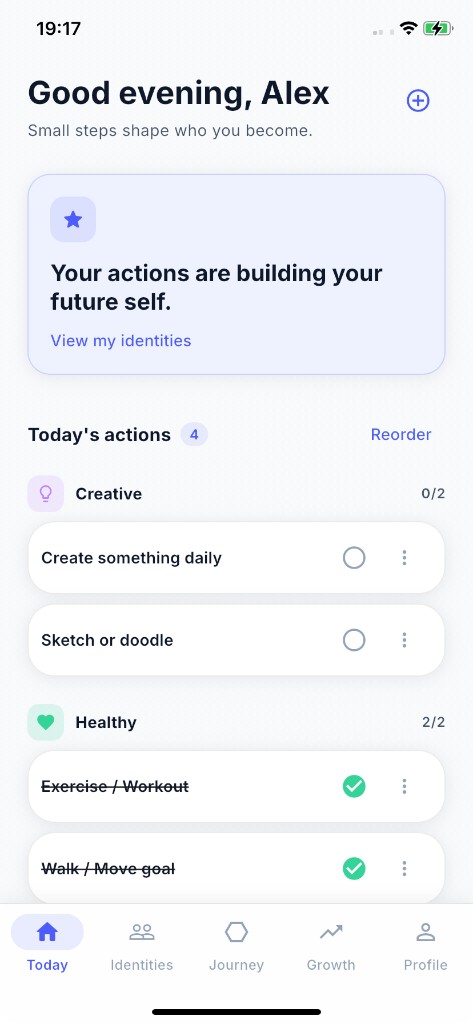
Ascend does not remove the discomfort of change, and it is not a substitute for professional support when the problem is clinical or acute. It is a structure for practicing a new identity in small daily actions and checking the evidence weekly.
The identity quiz can help if you know you want to change but do not know which identity to practice first. Clarity there makes everything else less chaotic.
Change is hard because you are not editing a habit list. You are negotiating with a self that was built over years. Go smaller, stay longer, and measure alignment instead of perfection. That is how the new identity gets enough proof to stick.
Change is still uncomfortable. The point is not to remove discomfort. It is to make the new identity familiar enough that discomfort no longer automatically sends you back to the old default.
Give change a season, not a weekend. Identity shifts need enough repetitions to survive the first stressful month, the first holiday, and the first ordinary week when nothing feels special. That is a longer timeline than most plans admit.
Most people quit change because they judge it too early. A few hard days in week three are not proof that the new identity failed. They are the part of the process where the old identity fights back hardest.
Expect resistance. Plan for it. Keep the next action small enough that resistance cannot use a bad day as proof that you were never serious.
Change gets easier when you stop asking it to feel inspiring and start asking it to feel repeatable.
Repeatable beats impressive every time when you are trying to change who you practice being.
That is not a downgrade. It is how change survives contact with a normal life.
FAQ
Why do I want to change but keep doing the same things?
Wanting to change is an intention. Doing the same things is an identity reinforced by repetition, environment, and hidden payoffs. Until the new identity gets small daily evidence, the old one will usually win close decisions.
How long does identity change actually take?
There is no fixed timeline, but identity shifts through patterns, not single moments. Weekly reviews over several months often reveal change long before it feels dramatic day to day.
Is Ascend free?
Ascend is free to download. Ascend Pro adds optional extras like unlimited identities and deeper insights via subscription.
Does my data leave my device?
Your identities, habits, and reviews are stored locally on your device by default.