
Consistency without streak anxiety
Consistency is a pattern, not a perfect record.
Becoming consistent is less about never missing a day and more about returning sooner, with habits small enough to survive real life.
Why streaks break people
Many habit apps teach you that consistency means an unbroken chain. Miss one day and the number resets to zero. That design turns a single bad morning into a moral crisis. People quit not because they cannot do the habit, but because the streak made one miss feel like total failure. The number becomes the identity. A life built on never missing is fragile, while a life built on returning is durable because it assumes you are human, not a machine that can protect a perfect chain forever.
Real consistency looks messier. You show up most days. You miss sometimes. You return quickly. Over months, the pattern matters more than any single gap. A life built on never missing is fragile. A life built on returning is durable because it assumes you are human, not a machine. Ask what ratio would satisfy you at year end, then design habits that make that ratio likely on ordinary weeks instead of chasing a streak that turns one miss into a moral crisis.
If streak anxiety has burned you before, redefine consistency as frequency over time, not perfection. Five days out of seven for twelve weeks is a strong pattern even if the chain has gaps. Ask what ratio would satisfy you at year end, then design habits that make that ratio likely on ordinary weeks. That pattern is practiced, not innate, and you change it by practicing Reliable with actions so small they are hard to skip on the days when your old script feels like home.
Consistency is an identity practice
Reinvention is editing who you practice being, not erasing your past. If you have been inconsistent for years, you have been practicing an identity too: someone who starts strong and fades, someone who negotiates with themselves, someone who needs a fresh Monday to try again. That pattern is practiced, not innate. Consistency does not mean doing everything every day; it means your default is return, not restart from zero with shame, and that edit takes months of small proof, not one perfect month.
You change that by practicing Consistent or Reliable with actions so small they are hard to skip. Same wake time. Minimum version of a key habit. A simple rule like never miss twice in a row. The identity shift is subtle until the log proves you return faster than you used to. Zero days teach your brain that the identity is optional whenever things get hard, while minimum versions keep the identity alive when life is loud and motivation is gone.
Consistency does not mean doing everything every day. It means your default is return, not restart from zero with shame. You are editing the story from "I always quit" to "I come back." That edit takes months of small proof, not one perfect month that collapses in week five. Define minimum versions in advance, not in the moment when you are already negotiating, because on a bad day the decision should already be made and you are not failing down.
The minimum version rule
On hard days, do the minimum version, not zero. Five-minute walk instead of a run. One page instead of a chapter. One set instead of a full workout. Minimum versions keep the identity alive when life is loud. Zero days teach your brain that the identity is optional whenever things get hard. Every decision is a chance for the old identity to win with a reasonable-sounding excuse, which is why boring anchors are durable anchors and exciting anchors depend on unreliable mood.
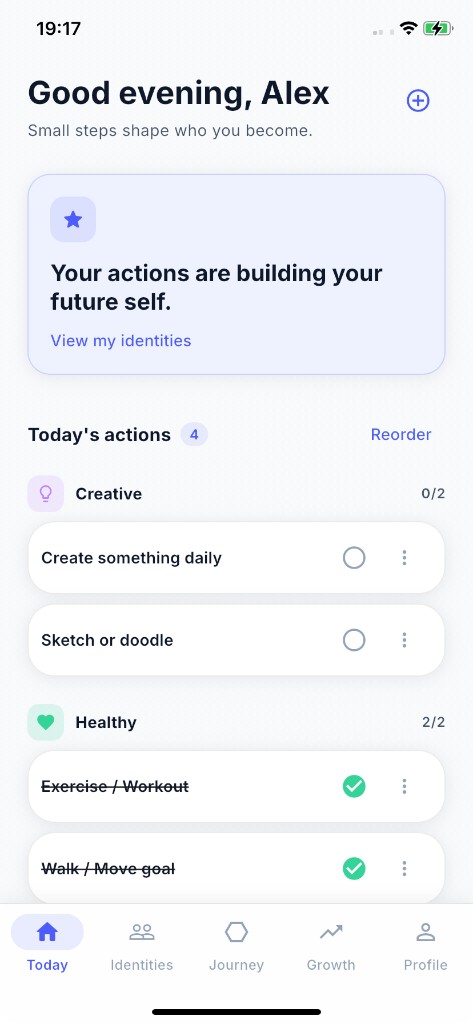
This is where most consistency plans fail. They were built for ideal conditions. Ascend lets you log the minimum as a win. The app is not going to drag you out of bed. It gives you a record that you returned, which makes the next return easier. Evidence beats intention on tired evenings. If a cue stops working, change the cue before you abandon the habit, because consistency is often a scheduling problem dressed up as a willpower problem you cannot shame away.
Define minimum versions in advance, not in the moment when you are already negotiating. Write them next to the full version in your plan. On a bad day, the decision is already made. You are not failing down. You are practicing consistency at the size your life can hold right now. Single days lie and weeks tell the truth about what your life actually supports right now, so review turns guilt into engineering that is kinder and more effective than nightly prosecution.
Ready to practice a different identity starting today?
Same time beats same motivation
Consistent people rely on cues more than inspiration. Same wake time. Same mug of coffee before writing. Same walk after lunch. Cues reduce the number of decisions between you and the action. Every decision is a chance for the old identity to win with a reasonable-sounding excuse. Celebrate return speed, not just hit rate, because if you used to disappear for two weeks after a miss and now return in two days, consistency is improving even when the streak is imperfect.
Pick one anchor habit and attach a new behavior to it. After I pour coffee, I open the document. After I close my laptop, I walk ten minutes. Boring anchors are durable anchors. Exciting anchors depend on mood. Mood is unreliable. Cues are repeatable even when you feel flat. The second miss is the warning light, and never miss twice is about preventing a bad day from becoming a bad month, not about demanding perfection on the hardest weeks you face.
If a cue stops working, change the cue before you abandon the habit. Maybe the time slot collided with a new obligation. Maybe the environment shifted. Consistency is often a scheduling problem dressed up as a willpower problem. Fix the cue, keep the identity. A harsh reset often triggers another dropout cycle, so shrink the habit gently, move it, and ask what got in the way before you quietly abandon the identity without noticing.
Review patterns, not single days
A weekly consistency review should answer: how many days did I practice this identity? Where did I slip? Was it predictable? Weekends? Late work nights? Travel? Single days lie. Weeks tell the truth about what your life actually supports right now. Consistency grows when the habit fits the life you actually have, not the life a productivity influencer pretends to have in a staged morning video with no dependents or surprises.
When you see patterns, you can fix systems instead of blaming willpower. Maybe the habit is too big. Maybe it needs a different time slot. Maybe you are trying to be consistent at something you do not actually value. Review turns guilt into engineering. That is a kinder and more effective frame. Use Ascend to see your ratio over time, not to chase a perfect streak, because the weekly review is the product and daily logs are inputs that should inform edits, not verdicts.
Celebrate return speed, not just hit rate. If you used to disappear for two weeks after a miss and now you return in two days, that is consistency improving even if the streak is not perfect. Trend lines matter more than any single week. Zoom out before you declare failure. Real consistency looks messier than apps teach, and you show up most days, miss sometimes, and return quickly because the pattern matters more than any single gap in the chain.
Never miss twice
One missed day is noise. Two missed days in a row is the start of a new pattern. A simple rule like "never miss twice" keeps consistency humane. You are allowed to be human. You are not allowed to quietly abandon the identity without noticing. The second miss is the warning light. Never miss twice keeps consistency humane: you are allowed to be human, but you are not allowed to drift for a month without noticing that the old identity is winning again.
If you miss twice anyway, reset without drama. Shrink the habit. Move it. Ask what got in the way. Consistency is maintenance, not punishment. A harsh reset often triggers another dropout cycle. A gentle shrink keeps the identity alive while you fix the design problem. The minimum version rule is where most plans fail because they were built for ideal conditions instead of the Thursday when you are sick, behind, and tempted to do zero.
Never miss twice is not about perfection on hard weeks. It is about preventing a bad day from becoming a bad month. The return vote can be tiny. It just has to happen. That vote is often the whole difference between an identity that sticks and one you only visit on fresh Mondays. Ascend lets you log the minimum as a win, giving you a record that you returned, which makes the next return easier when evidence beats intention on tired evenings.
What Ascend will not do for consistency
Ascend will not block your phone, automate your schedule, or guarantee you never miss a day. It helps you name identities, track actions, and review weeks honestly. Consistency still requires habits that fit your real life and choices you make when nobody is scoring you. Pick one anchor habit and attach a new behavior to it after coffee, after closing the laptop, or after locking the door, because weak anchors produce weak stacks that collapse quickly.
If your environment makes consistency impossible, no app fixes that alone. You may need boundaries, support, or fewer commitments. Consistency grows when the habit fits the life you actually have, not the life a productivity influencer pretends to have in a staged morning video. When you see patterns in review, fix systems instead of blaming willpower, maybe the habit is too big, poorly timed, or attached to something you do not actually value yet.
Use Ascend to see your ratio over time, not to chase a perfect streak. The weekly review is the product. Daily logs are inputs. If the review shows improvement, you are becoming consistent even when individual days look messy. Trust the pattern, then keep editing the plan. Trust the pattern, then keep editing the plan, because trend lines matter more than any single week when you are building consistency that survives contact with real life.
FAQ
How many days until a habit feels consistent?
Many people feel a rhythm in three to six weeks, but identity-level consistency often takes longer. Focus on return speed after misses rather than a perfect streak.
What if I keep failing on weekends?
Weekend failure is usually a design problem. Shrink the weekend version of the habit, change the cue, or schedule it earlier before social plans take over. Review the pattern before restarting harder on Monday.
Is Ascend free?
Ascend is free to download. Ascend Pro adds optional extras like unlimited identities and deeper insights via subscription.
Does my data leave my device?
Your identities, habits, and reviews are stored locally on your device by default.