
When the life you planned stopped mid-sentence
Breakup recovery is daily proof you still exist outside the relationship.
Grief after a breakup is not weakness. It is your nervous system adjusting to a new shape of life. Recovery means small actions that rebuild you, slowly, without pretending you are fine.
A breakup is identity whiplash
You were not just with someone. You were someone who had plans for next summer, inside jokes about the neighbor's dog, a default person to text about lunch at 12:30. When the relationship ends, you lose a version of yourself you were practicing every day without noticing until it is gone.
Friends mean well when they say you will be fine eventually. You probably will be. That does not help at 2am when your body still reaches for the phone to share something small. Grief is not a sign you made the wrong choice. It is what happens when a major thread of your life gets cut and nothing rewires overnight. Dramatic trips can postpone grief without teaching your body how to live on a random Wednesday when nothing is planned.
Recovery is not "getting over it" on a deadline your friends set or your ex seems to have met. It is rebuilding evidence slowly that you are still a person with a life, not flipping a switch to pretend nothing happened. The relationship mattered. Pretending otherwise usually makes the nights longer. On the days you cannot manage more, one glass of water and a shower still count as proof you are still here.
Why staying busy fails as a strategy
The first instinct is often distraction: last-minute travel, overtime, dating apps, anything to avoid the quiet where their name still lives. Distraction can carry you through the first shock when basics feel impossible. It rarely heals the part that needs steadiness and honest contact with what happened. A weekly text to one friend is enough to keep the door open when you do not want to explain the whole story again.
Busy recovery looks like progress until you stop moving and everything crashes back harder than before. Slow recovery looks boring from the outside: journaling ten minutes, one act of self-care, reaching out to one friend who does not need the full story. Those votes add up in ways dramatic escapes do not. Urges to check their profile usually peak late at night when loneliness is loudest and judgment is lowest.
You are not trying to erase the relationship or prove you never cared. You are trying to become someone who can carry the loss without letting it define every hour. That identity rebuilds through small repeated proof, not through one busy month that collapses when the trip ends. A bad weekend does not erase three weeks of basics you actually maintained when you compare months, not hours.
Self-care is evidence, not indulgence
After a breakup, basic care slips first: meals, shower, bed at a reasonable hour, answering texts from people who are not your ex. Tracking one small self-care action daily is not spa marketing. It is proof you are still worth caring for when part of you disagrees loudly at 9pm. Grief and forward motion can share the same calendar without canceling each other out or meaning you never cared.
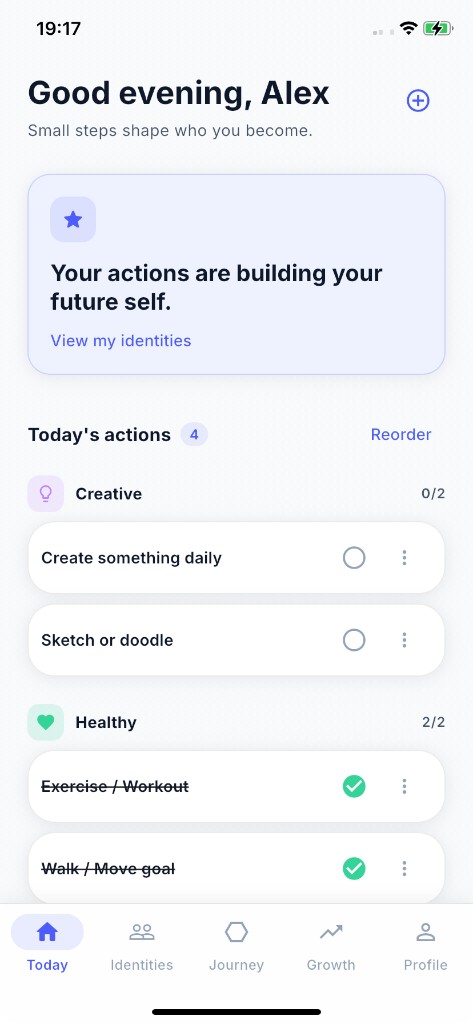
The Healing identity in a recovery plan might include journaling, one kind thing for yourself, and boundaries around contact with your ex if that is needed. None of those fix heartbreak on a schedule. They keep you from disappearing while heartbreak runs its course at its own speed. You do not have to feel ready to heal in order to do one small kind thing for yourself today.
Ascend does not replace therapy, friendship, or the long conversations you need with people who know you. It gives you a simple place to log that you showed up for yourself on the days that feel impossible. That log matters when your brain insists you did nothing all week. Recovery is rebuilding evidence slowly that life has a shape outside the relationship, not flipping a switch to fine.
Ready to practice a different identity starting today?
Connection habits beat isolation spirals
Isolation feels protective when explaining the story again sounds exhausting. You do not want pity eyes or advice you did not ask for. Long isolation makes everything heavier and shrinks the world to your apartment and your phone. One message to one friend per week is a low bar that still breaks the spiral. Friends who say move on mean well, but your timeline is allowed to be slower than their comfort with your pain.
Connected identity habits are intentionally small: reach out weekly, reflect on progress Sunday night without performing healed. You are not auditioning for "I am over it." You are maintaining threads to the world outside the breakup so grief does not become your only companion.
Your weekly review might show you skipped people for two weeks. That is data, not failure. Adjust the next week, lower the bar if needed, try again. Recovery wobbles. The point is to notice the wobble instead of letting it become the new normal silently.
Contact boundaries are habits too
Checking an ex's social media at midnight is a habit loop like any other. It gives a hit of connection and prolongs pain in the same breath. Limiting contact, if you need to, is a repeated choice not a one-time rule you announce and then break at 11pm when loneliness spikes.
Some breakups require ongoing contact for kids, shared housing, or work. Boundaries there are smaller and more specific: which topics are off limits, which hours you answer, what you do when they push. Track what you actually do, not what you wish you did in a calmer moment.
This is where honest limitation matters. An app will not block their profile or delete their number. Structure helps you see the pattern and choose differently more often. Recovery is rebuilding evidence slowly that you can tolerate the urge without always feeding it.
What progress looks like at week four and week twelve
Early weeks are survival mode. You might only manage basics and feel foolish tracking a shower as a win. By week four, some days have an hour that does not hurt as sharply. By week twelve, the relationship is still sad but no longer the only thing you think about before coffee.
Nonlinear is normal, not a sign you are doing it wrong. A song, a photo, a restaurant you used to share can knock you back for a day or a weekend. That does not erase the weeks of small proof you built. Compare months, not afternoons, when you judge progress.
If you are not functioning at all, if you are not eating, or if you feel unsafe, reach out to a professional or someone you trust immediately. Daily habits support recovery. They do not replace care when you are in crisis or when grief turns into something darker.
Rebuild the daily shape of your life
Import a breakup recovery plan to start with Healing and Connected identities, journaling, self-care, and weekly reflection already set up. Adjust habits to fit your life instead of building from scratch while you are grieving and cannot decide what day it is.
You are not racing to be ready to date or to prove you moved on faster than they did. You are becoming someone who can wake up, care for themselves, and stay tethered to people who are not your ex. That is the daily shape recovery rebuilds.
That identity rebuilds slowly, and slow is not falling behind. It is how real recovery works when you stop measuring yourself against the fantasy of a clean break that never hurt. Evidence accumulates in ordinary Tuesdays, not in dramatic announcements.
FAQ
How long should breakup recovery take?
There is no standard timeline. Losing a long relationship can take many months to feel steady. Track small weekly improvements in self-care and connection rather than waiting to feel "over it."
Is it okay to still love them and recover at the same time?
Yes. Recovery is not erasing love. It is building a life that is not only organized around the relationship that ended.
Is Ascend free?
Ascend is free to download. Ascend Pro adds optional extras like unlimited identities and deeper insights via subscription.
Does my data leave my device?
Your identities, habits, and reviews are stored locally on your device by default.