
When the job ended before you were ready
Redundancy recovery is routine plus momentum, not panic.
Losing a job hits identity and income at once. Recovery means keeping a daily shape to your life while you rebuild professional proof, one small action at a time.
Redundancy is a grief event with a spreadsheet
You lose more than a paycheck when redundancy lands. You lose a title, a rhythm, people who knew your name in the hallway, and a story about who you are from nine to five that felt solid until Thursday's meeting. Even when the logic makes sense on paper, the feeling often does not match the spreadsheet.
Some days you want to apply to everything before lunch. Other days you cannot open LinkedIn without nausea and a tight chest. Both reactions are human, and neither means you are failing at recovery or not trying hard enough. Recovery is not choosing between grief and action. It is making room for both at a sustainable pace. Guilt on slow days is common and usually means you need structure, not more self-attack disguised as discipline.
Rebuilding evidence slowly beats flipping a switch to "hustle mode" for two weeks and then crashing into shame and silence. Your next role will care about steady momentum more than the story you tell yourself about how hard you pushed in week one. One tailored application on Tuesday often beats ten rushed ones on Friday when shame spikes and quality collapses.
Why unstructured time feels like failure
Work gave you a container whether you liked it or not. Wake, commute, tasks, home, repeat. Without it, hours blur until you end a day unsure what you did and feel guilty for not doing more, even when you sent applications and updated your CV. A short message to a former colleague can break the isolation that makes rejection feel personal and permanent.
Routine anchors are not fake productivity to perform for relatives who ask what you do all day. A consistent wake time, one job-search action, and a weekly review give the week a shape your brain can trust. You are still working toward something even when offers are slow and silence is loud. Skipping lunch to send more applications often produces worse cover letters, not better odds or faster offers.
The Resilient identity is someone who shows up professionally for themselves, not someone who sends fifty applications while burned out and calls it discipline. Small repeated proof beats another panic sprint that ends Friday with nothing tailored and your confidence lower than Monday. Silence from recruiters is feedback about timing and fit, not a measure of your value as a professional.
One job-search action beats a marathon of guilt
Panic applying often produces sloppy applications and silence that feels personal. One deliberate action daily, update a CV section, reach out to one contact, tailor one cover letter, keeps momentum without pretending you are a machine that can ignore rejection until it stops hurting. You are still a professional between roles, even when the title field on forms feels empty and humiliating.
Track the action, not just the outcome. Rejections are noisy and arrive in batches. Consistency is signal your future self needs when motivation disappears at 4pm. Your weekly review shows whether you maintained momentum when nobody could see it, which employers cannot measure but you need to know. Routine anchors tell your brain the week has shape even when the market responds slower than your anxiety demands.
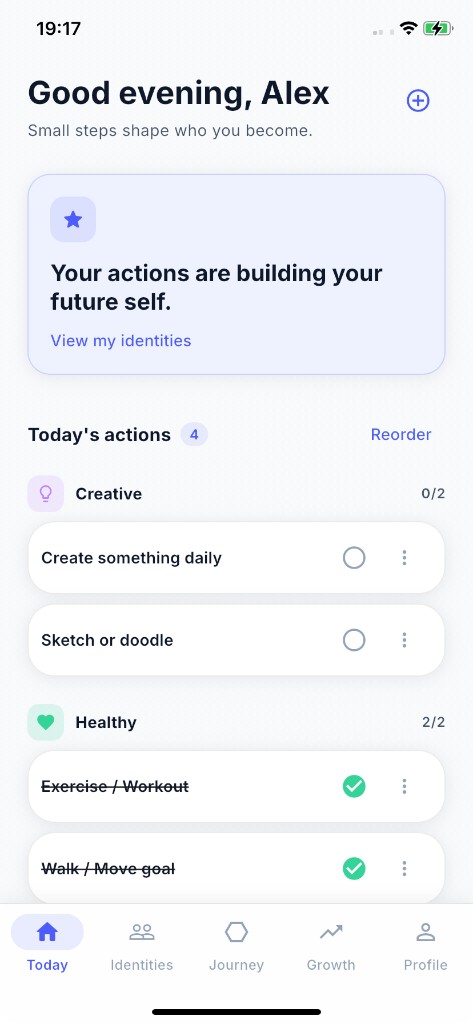
Ascend will not find you a job, write your CV, or open doors in your industry. It helps you prove to yourself that you are still in motion on the weeks when the inbox stays quiet. That proof protects self-worth when the market is slow. Recovery is rebuilding evidence slowly that you can keep moving, not flipping a switch to hustle mode for two weeks.
Ready to practice a different identity starting today?
Connection is part of recovery, not networking theater
Reach out to one professional contact per week sounds small until you have been isolated for a month. It breaks loneliness and sometimes opens doors you did not know existed. The goal is not performative networking at every coffee shop with a rehearsed elevator pitch. Track actions, not just outcomes, because rejections are noisy and consistency is the signal you need in month three.
Connected identity habits keep you from vanishing into your head where rejection echoes louder. A message, a call, a coffee if you have the energy. Evidence you are still part of a professional world even when you are between roles and the title field on forms feels humiliating. Ascend will not find you a job, but it can show you stayed in motion when motivation disappeared after another silence.
If social contact feels impossible some weeks, note that in review and try again without declaring yourself broken. Recovery wobbles. The habit is returning to one outreach, not maintaining a perfect networking streak that nobody asked for. Financial fear makes basics feel frivolous until you notice how much worse applications get when you are depleted.
Protect basics when money is scary
Financial stress makes everything harder and shrinks your window for clear thinking. You might skip meals, sleep badly, or stop exercising because it feels frivolous when the mortgage date is approaching. Those basics are load-bearing, not luxuries you earn after the offer letter arrives. Weekly review separates what you controlled from what the market did, which protects self-worth during slow seasons.
A short walk and regular wake time are not indulgent when you are job searching. They keep the search from happening in a depleted body that cannot write a sharp paragraph at 10am. Be honest about what you can cut and what you cannot without making week three impossible. Connected habits are about staying human in a search that can feel private, shameful, and endlessly one-sided.
Professional support for money and mental health exists in many regions. Apps do not replace that when stress is acute. Ascend tracks habits alongside other help, not instead of benefits advice, therapy, or conversations with people who can actually lend support. Compare this week to last week, not to the month before redundancy when everything felt more certain.
Weekly review when the market is slow
You can do everything right and still wait months with little feedback. Weekly review separates "I did my part" from "the market responded," which protects your self-worth when silence is the main message in your inbox. Small proof accumulates: one outreach, one wake time, one review note that says you showed up again.
Look at applications sent, conversations started, and routine held even on the bad days. Adjust one variable next week. Maybe your CV needs a sharper top line. Maybe your energy craters on day four and you need a lighter Wednesday with one task instead of three.
Slow hiring seasons are not personal verdicts on your value. They are context that makes patience harder and structure more important. Recovery is rebuilding evidence slowly that you can keep going without toxic hustle or giving up entirely.
Rebuild professional identity before the offer arrives
Import a redundancy recovery plan with Resilient and Connected identities, daily job-search action, routine wake time, and weekly progress review. You are practicing being someone who manages a transition with dignity, not someone waiting to become real again when a recruiter finally replies.
The next role will come on a timeline you cannot fully control. Between now and then, you are collecting proof you can still act, connect, and hold a shape to your days. That proof is what recovery looks like here, not a feeling you chase between applications.
That proof is slow, visible, and real. A month of logged actions is more trustworthy than one frantic week you cannot repeat. Let the evidence accumulate while the market moves at its own speed.
FAQ
How many applications should I send per day?
Quality beats volume. One tailored application or one meaningful outreach often beats ten generic submissions. Track consistency over a week instead of obsessing over a daily number.
How do I stay motivated during a long job search?
Motivation will dip. Routine and small tracked actions keep you moving when inspiration does not. Weekly review shows progress that rejection emails hide.
Is Ascend free?
Ascend is free to download. Ascend Pro adds optional extras like unlimited identities and deeper insights via subscription.
Does my data leave my device?
Your identities, habits, and reviews are stored locally on your device by default.