
Reinvention at 30
Thirty is not a deadline. It is an edit.
Reinventing yourself at 30 is less about burning your old life down and more about choosing which parts of you get more practice from here.
Why thirty feels like a reckoning
A lot of people hit thirty and realise they have been living on autopilot. The job made sense at twenty-four. The social circle formed by accident. The habits that felt fine in your early twenties start to feel like leftovers from someone else's plan. That discomfort is not a sign you failed. It is often the first honest signal that your current identity and your desired identity have drifted apart.
The trap is treating thirty like a hard reset button. Social media loves the dramatic version: quit everything, move cities, become a new person by Monday. Real reinvention at thirty is usually quieter. You keep most of your history, your skills, and your relationships. You change what you repeat on ordinary Tuesdays. Nobody needs a parade to mark the edit. The work happens in private long before anyone notices.
Thirty also brings sharper comparisons. Friends buy houses, change careers, or seem settled in ways you are not. Comparison is a terrible compass because it ignores context you cannot see from outside. Your reckoning is about alignment, not ranking. Ask whether your daily life still fits who you are becoming, not whether you are winning an invisible race against curated highlights.
Reinvention is editing, not erasing
Reinvention is editing who you practice being, not erasing your past. The version of you who stayed in a job too long, dated the wrong person, or ignored their health for three years still taught you something. Maybe you learned what you will not tolerate. Maybe you learned you are more resilient than you thought. Those lessons are not baggage. They are context you can use for smarter choices tomorrow.
Editing means you stop defending habits that no longer match who you want to become. You do not need to perform shame about the last decade. You need a few new defaults: what you do after work, how you spend the first hour of the day, which commitments you keep saying yes to out of guilt. The edit is in the repetition, not the announcement.
Erasing fantasies feel clean because they skip grief. Editing is messier because you carry forward mixed feelings about who you were. That mess is honest. You are not building a new person from scratch. You are redirecting practice toward a version of yourself that already exists in small moments you have been ignoring. You are redirecting practice toward a version of yourself that already shows up in small moments you have been ignoring because they did not feel dramatic enough to count as change.
Start with one identity, not ten goals
Most thirty-year-old reinvention plans collapse because they look like a New Year's resolution list for an entirely different human. Run a marathon, learn Spanish, get promoted, meditate, meal prep, date intentionally, read fifty books. That is not reinvention. That is overload with better branding. Ten goals is how you prove to yourself that change is impossible. Overload with better branding is still overload, and it teaches your brain that reinvention is impossible when the real problem is too many competing promises at once.
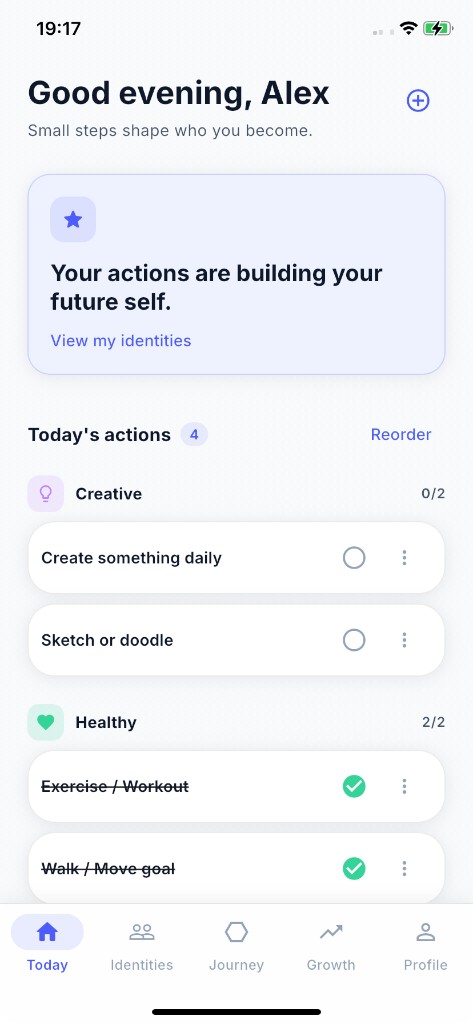
Pick one identity that would make the next five years feel different. Someone who trains. A person who creates. Someone who protects their energy. Attach two or three small daily actions to that identity. If you cannot name the identity in one sentence, you are probably still shopping for outcomes instead of practice. If you cannot name the identity in one plain sentence, you are probably still shopping for outcomes instead of choosing who gets your next season of daily practice.
Ascend is built for this shape: name the identity, log the votes, review the week. It will not choose the identity for you, and it will not fix your career or relationship problems on its own. It gives you a place to practice being someone slightly different before the evidence feels obvious. That lag is normal, not a sign the approach failed. Ascend fits this shape, but it will not choose the identity for you or fix career and relationship problems; it only gives you a place to log votes before the evidence feels obvious.
Ready to practice a different identity starting today?
The decade you already lived is data
Before you add new habits, spend one honest hour on what your twenties actually trained you to do. Not what you wish you had done. What you did when you were tired, lonely, or bored. Late-night scrolling. Saying yes to plans you resented. Letting health slide every busy season. Those patterns are not moral failures. They are practiced identities. Those practiced identities under stress are data, not moral failures, and honest data is what makes your next habit design realistic enough to survive a tired Wednesday evening.
Use that data to design replacements that are small enough to survive a normal week. If you always crash on the sofa after work, your reinvention plan cannot depend on a two-hour gym session five nights a week. A ten-minute walk after dinner is boring. Boring is often what works at thirty, when life is already full. Boring is often what works at thirty, when life is already full and your reinvention plan must fit the sofa crash instead of fighting it with fantasy discipline.
Write down your top three default behaviors under stress. For each one, ask what need it meets and what smaller action could meet part of that need with less regret later. You are not deleting coping skills overnight. You are negotiating upgrades that your tired self might actually accept on a Wednesday. You are negotiating upgrades your tired self might actually accept, not deleting coping skills overnight and then wondering why you slid back into the old script by Friday.
What to do in the first thirty days
Week one: name one identity and one non-negotiable action. Not three identities and twelve habits. One action you can complete even on a bad day. Week two: add a second action only if the first is happening at least four days out of seven. Week three: notice your triggers. When do you slip back into the old script?. One action on a bad day beats twelve actions on paper, because reinvention at thirty is built from returns, not from plans that only work when you feel like a different person.
Triggers are useful information, not character indictments. After drinks with certain friends? Sunday evenings? Commute home? Name the pattern without turning it into a verdict about who you are. Week four: run a weekly review. Not a performance review. A pattern review. Did your actions match the person you said you were becoming?. Name the trigger without a verdict, then adjust the habit size before you adjust your self-esteem, because pacing problems masquerade as character problems more often than people admit.
If not, adjust the action size before you adjust your self-esteem. Reinvention at thirty is usually a pacing problem, not a character problem. Shrink the habit, move the time slot, or drop the second action until the first one sticks. Consistency at a small scale beats ambition that collapses by day nine. Consistency at a small scale beats ambition that collapses by day nine, especially when your calendar already contains obligations you cannot pretend away for a montage-friendly month.
What actually changes by thirty-five
You will not wake up one morning as a completely different person. What changes is the weight of evidence. After six months of small votes, you have a record. You are someone who shows up for morning movement, or creative work, or financial tracking, more often than you used to. That record changes how you talk to yourself when motivation dips. That record changes how you talk to yourself when motivation dips, because you can point to weeks where you practiced the identity even when results were still invisible to everyone else.
The people around you may not notice for a while. That is fine. Reinvention at thirty is often private long before it is visible. The point is not to impress anyone at a reunion. The point is to stop feeling like you are cosplaying your own life. Internal alignment usually arrives before external applause. Internal alignment usually arrives before external applause, and that order is normal; you are allowed to feel the shift privately long before anyone at a reunion would notice.
By thirty-five, many people also have clearer boundaries because they practiced saying no in small ways. They know which identities they are willing to maintain and which fantasies they can release. The edit compounds. You are still you, with history intact, but the daily story starts to match the story you tell yourself in quiet moments. The edit compounds quietly: clearer boundaries, fewer guilt-driven yeses, and a daily story that starts to match what you tell yourself in moments when nobody is performing for an audience.
Honest limits on what an app can do
Ascend can help you practice a new identity with daily actions and a weekly review. It cannot replace therapy, career coaching, or hard conversations you have been avoiding. If your reinvention requires leaving a relationship or a job, no habit tracker will do that for you. Real decisions still need real courage outside the app. Real decisions about jobs and relationships still need real courage outside any app, because no tracker can have the conversation you have been avoiding or choose your next chapter for you.
What it can do is stop reinvention from living only in your head. Import a starter plan, adjust the habits to your real schedule, and treat the app as a logbook of who you are practicing being. The past stays with you. The next chapter is built in small, repeatable edits you can point to when doubt shows up. Treat the logbook as proof when doubt shows up, not as a substitute for therapy, coaching, or the harder work that notifications cannot complete on your behalf this month.
If you need crisis support, financial planning, or medical care, get that help first. Ascend is structure for ordinary days, not an emergency service. Use it where daily practice matters. Do not use it to postpone the harder work that no notification can complete for you. Get crisis support, financial planning, or medical care first when that is what you need; Ascend is structure for ordinary days, not an emergency service or a reason to postpone necessary help.
FAQ
Is thirty too late to reinvent yourself?
Thirty is early for a long life and late for pretending your habits are temporary. Reinvention at this age works best when you treat it as editing your daily practice, not erasing a decade. Small identity-based actions compound over years.
How is reinventing yourself different from setting goals?
Goals end. Identities keep collecting evidence. Instead of "get fit by summer," you practice being someone who moves most days. That framing survives missed weeks better than a single outcome deadline.
Is Ascend free?
Ascend is free to download. Ascend Pro adds optional extras like unlimited identities and deeper insights via subscription.
Does my data leave my device?
Your identities, habits, and reviews are stored locally on your device by default.